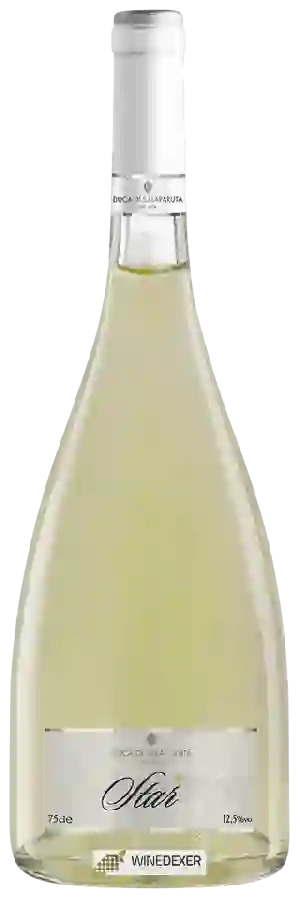
Winery Duca di SalaparutaStar
 White wine


In the mouth this white wine is a powerful.
This wine generally goes well with vegetarian, appetizers and snacks or shellfish.

Taste structure of the Star from the Winery Duca di Salaparuta
Light | Bold | |
Dry | Sweet | |
Soft | Acidic |
In the mouth the Star of Winery Duca di Salaparuta in the region of Sicily is a powerful.
Food and wine pairings with Star
Pairings that work perfectly with Star



Original food and wine pairings with Star
The Star of Winery Duca di Salaparuta matches generally quite well with dishes of shellfish, vegetarian or appetizers and snacks such as recipes of salt and pepper shrimp, quiche with bacon and gruyère cheese or preparation of the green olives.
Details and technical informations about Winery Duca di Salaparuta's Star.
Discover the grape variety: Chardonnay
Whites with many faces: mineral and taut at Chablis (lemon, green apple, flint), opulent and buttery at Meursault and Puligny-Montrachet (hazelnut, brioche, yellow fruits), tense and chalky in Champagne (Blanc de Blancs). Also vinified sparkling and widely exported (Sonoma, Margaret River, Casablanca). A Burgundian variety, a cross of Pinot Noir × Gouais Blanc, half-sibling of Aligoté.
Last vintages of this wine

The best vintages of Star from Winery Duca di Salaparuta are 2013, 2015, 2016, 0 and 2014.
Informations about the Winery Duca di Salaparuta
The Winery Duca di Salaparuta is one of of the world's great estates. It offers 37 wines for sale in the of Sicily to come and discover on site or to buy online.

The wine region of Sicily
Major qualitative renewal. Sunny, expressive reds: fleshy, spicy Nero d'Avola (black cherry, blackberry, liquorice), fine, mineral Nerello Mascalese on Etna (recalls Pinot Noir), light, crisp Frappato in Cerasuolo di Vittoria DOCG. Lively, saline whites: Catarratto, fat, iodised Grillo, taut Carricante, floral Inzolia. Amber, walnutty fortified Marsala.
The word of the wine: Tanin
A natural compound contained in the skin of the grape, the seed or the woody part of the bunch, the stalk. The maceration of red wines allows the extraction of tannins, which give the texture, the solidity and also the mellowness when the tannins are "ripe". The winemaker seeks above all to extract the tannins from the skin, the ripest and most noble. The tannins of the seed or stalk, which are "greener", especially in average years, give the wine hardness and astringency. The wines of Bordeaux (based on Cabernet and Merlot) are full of tannins, those of Burgundy much less so, with Pinot Noir containing little.