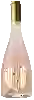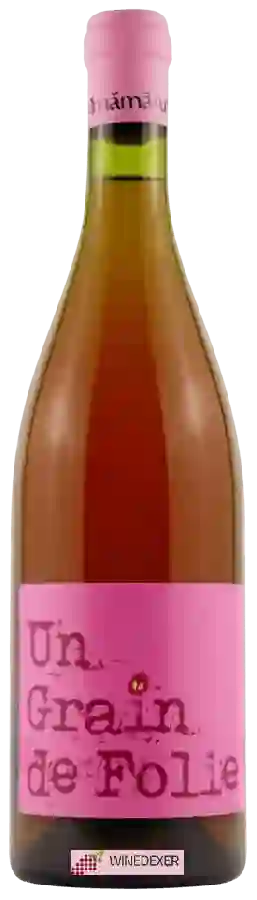
Domaine MamarutaUn Grain de Folie Rosé
 Pink wine



This wine generally goes well with beef, lamb or mature and hard cheese.
Wine flavors and olphactive analysis

On the nose the Un Grain de Folie Rosé of Domaine Mamaruta in the region of Languedoc-Roussillon often reveals types of flavors of strawberries, raspberry or lychee and sometimes also flavors of microbio, red fruit or tropical fruit.
Food and wine pairings with Un Grain de Folie Rosé
Pairings that work perfectly with Un Grain de Folie Rosé



Original food and wine pairings with Un Grain de Folie Rosé

The Un Grain de Folie Rosé of Domaine Mamaruta matches generally quite well with dishes of beef, lamb or spicy food such as recipes of wild boar stew in burgundy style, lamb tagine with olives and honey or moroccan chicken tagine.
Details and technical informations about Domaine Mamaruta's Un Grain de Folie Rosé.
Discover the grape variety: Malvoisie de Toscane
It was cultivated in ancient times and is believed to be of Greek origin. In Italy, associated with Trebbiano Toscano, it was used to produce the famous Chianti: these two white varieties are no longer part of the vineyard. In France, Tuscan Malvasia is practically unknown. It should be noted that many grape varieties have "malvasia" as a synonym, so confusion between them is always possible.
Last vintages of this wine
The best vintages of Un Grain de Folie Rosé from Domaine Mamaruta are 2017, 2018
Informations about the Domaine Mamaruta
The Domaine Mamaruta is one of of the world's greatest estates. It offers 14 wines for sale in the of Languedoc-Roussillon to come and discover on site or to buy online.

The wine region of Languedoc-Roussillon
Languedoc (formerly Coteaux du Languedoc) is a key appellation used in the Languedoc-Roussillon wine region of southern France. It covers Dry table wines of all three colors (red, white and rosé) from the entire region, but leaves Sweet and Sparkling wines to other more specialized appellations. About 75% of all Languedoc wines are red, with the remaining 25% split roughly down the middle between whites and rosés. The appellation covers most of the Languedoc region and almost a third of all the vineyards in France.
The word of the wine: Musty (taste of)
A disgusting taste due to a defect in the grapes or, more commonly, a defect in the barrel.