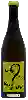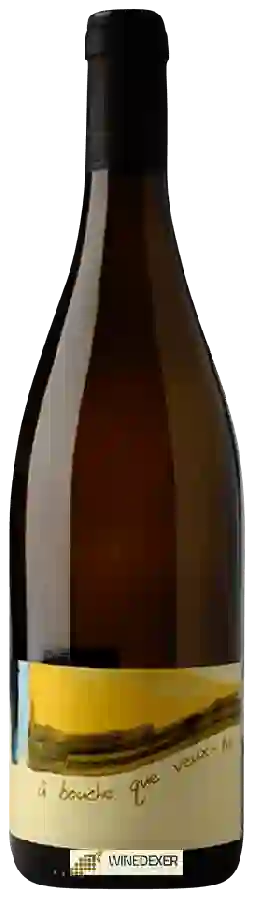
Domaine les Terres PromisesÀ Bouche Que Veux - Tu
 White wine



This wine is a blend of 3 varietals which are the Rolle, the Ugni blanc et rose and the Ugni blanc.
In the mouth this white wine is a with a nice freshness.
This wine generally goes well with vegetarian, poultry or appetizers and snacks.
Taste structure of the À Bouche Que Veux - Tu from the Domaine les Terres Promises
Light | Bold | |
Dry | Sweet | |
Soft | Acidic |
In the mouth the À Bouche Que Veux - Tu of Domaine les Terres Promises in the region of Pays d'Oc is a with a nice freshness.
Wine flavors and olphactive analysis





On the nose the À Bouche Que Veux - Tu of Domaine les Terres Promises in the region of Pays d'Oc often reveals types of flavors of butter, earth or microbio and sometimes also flavors of oak, tree fruit or citrus fruit.
Food and wine pairings with À Bouche Que Veux - Tu
Pairings that work perfectly with À Bouche Que Veux - Tu



Original food and wine pairings with À Bouche Que Veux - Tu



The À Bouche Que Veux - Tu of Domaine les Terres Promises matches generally quite well with dishes of rich fish (salmon, tuna etc), shellfish or spicy food such as recipes of fish balls, soupions à la provençale or chicken breast with curry and mushrooms.
Details and technical informations about Domaine les Terres Promises's À Bouche Que Veux - Tu.
Discover the grape variety: Rolle
Rolle is a white grape variety of Turkish origin that has become established in the South of France, particularly in the Var region, in Corsica under the name of Vermentinu, and in Italy. Its bunches and berries, of medium size, change from white to pink when the grapes are ripe. The rolle likes hot climates where the soil is dry and poor. On the other hand, it fears the wind and diseases. It produces fat, well-balanced white wines. These wines may lack acidity, but they are still very aromatic and give off notes of grapefruit, white fruit, white flowers, fennel, etc. Rolle is also a good table grape that can be enjoyed both fresh and dry. Present in Provence, Languedoc, Roussillon and Corsica. It is used in the composition of numerous appellations such as Ajaccio, Patrimonio, Bandol, Coteaux-d'Aix-en-Provence, Côtes-de-Provence, Costières-de-Nîmes, Corbières, Collioure, Côtes-de-Roussillon, Minervois, Saint Chinian...
Last vintages of this wine
The best vintages of À Bouche Que Veux - Tu from Domaine les Terres Promises are 2021, 2020, 2016, 0 and 2019.
Informations about the Domaine les Terres Promises
The Domaine les Terres Promises is one of of the world's greatest estates. It offers 17 wines for sale in the of Vin de Pays to come and discover on site or to buy online.

The wine region of Vin de Pays
Vin de Pays (VDP), the French national equivalent of PGI (Protected Geographical Indication) at the European level, is a quality category of French wines, positioned between Vin de Table (VDT) and Appellation d'Origine Contrôlée (AOC). This layer of the French appellation system was initially introduced in September 1968 by the INAO, the official appellation authority. It underwent several early revisions in the 1970s, followed by substantial changes in September 2000 and again in 2009, when all existing VDT titles were automatically registered with the European Union as PGI. Producers retain the choice of using either the VDP or PGI titles on their labels, or both - in the form "IGP-Vin de Pays".
The wine region of Pays d'Oc
Pays d'Oc is the PGI for red, white and rosé wines that are produced over a wide area of the southern coast of France. The PGI catchment area corresponds roughly to the Languedoc-roussillon">Languedoc-Roussillon wine region, one of the largest wine regions in France. The area covers all wines that are not produced under the strict laws that govern AOC-level appellations in the regions: among them, Corbières, Minervois and the Languedoc appellation itself. The Pays d'Oc PGI is arguably the most important in France, producing the majority of the country's PGI wines.
The word of the wine: Concentrate
Said of a wine that is rich in all its components (sugars in sweet wines, tannins in red wines, aromatic compounds) and that leaves an impression of density, intensity and depth.