The Domaine de la Bâtie of Saint-Véran of Burgundy
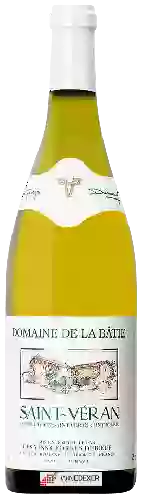
The Domaine de la Bâtie is one of the largest wineries in the world. It offers 1 wines for sale in of Saint-Véran to come and discover on site or to buy online.
Looking for the best Domaine de la Bâtie wines in Saint-Véran among all the wines in the region? Check out our tops of the best red, white or effervescent Domaine de la Bâtie wines. Also find some food and wine pairings that may be suitable with the wines from this area. Learn more about the region and the Domaine de la Bâtie wines with technical and enological descriptions.
How Domaine de la Bâtie wines pair with each other generally quite well with dishes of pasta, vegetarian or cured meat such as recipes of pasta with broccoli, spinach and goat cheese quiche or home-made coq au vin.
On the nose the white wine of Domaine de la Bâtie. often reveals types of flavors of earth. In the mouth the white wine of Domaine de la Bâtie. is a .
The wine region of Saint-Véran is located in the region of Mâconnais of Burgundy of France. Wineries and vineyards like the Domaine Collovray & Terrier or the Domaine Collovray & Terrier produce mainly wines white and red. The most planted grape varieties in the region of Saint-Véran are Chardonnay, Pinot noir and Nebbiolo, they are then used in wines in blends or as a single variety. On the nose of Saint-Véran often reveals types of flavors of butterscotch, yellow apple or chalk and sometimes also flavors of yeast, banana or kiwi.
In the mouth of Saint-Véran is a powerful. We currently count 360 estates and châteaux in the of Saint-Véran, producing 642 different wines in conventional, organic and biodynamic agriculture. The wines of Saint-Véran go well with generally quite well with dishes of pasta, rich fish (salmon, tuna etc) or shellfish.
Planning a wine route in the of Saint-Véran? Here are the wineries to visit and the winemakers to meet during your trip in search of wines similar to Domaine de la Bâtie.
- Origin: This variety is widely cultivated in Austria. It is believed to be the result of a natural intraspecific cross between Savagnin and another ancient Austrian variety called Saint Georgen. It can also be found in the northeastern part of Italy, in Germany, Hungary, Romania, Russia, the Czech Republic, Slovakia, Moravia, Croatia, the United States (Oregon, Maryland, etc.), Australia, New Zealand and Canada.


