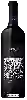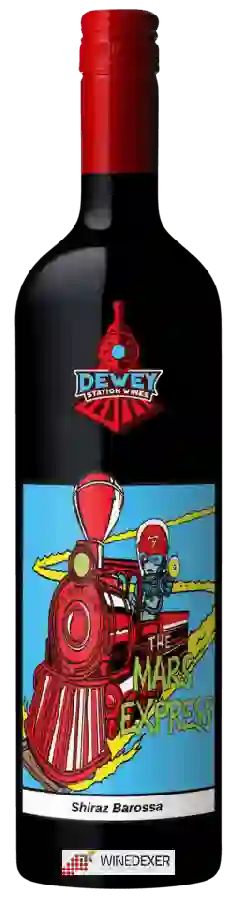
Winery Dewey Station WinesThe Mars Express Shiraz
 Red wine


In the mouth this red wine is a powerful with a nice balance between acidity and tannins.
This wine generally goes well with poultry, beef or game (deer, venison).

Taste structure of the The Mars Express Shiraz from the Winery Dewey Station Wines
Light | Bold | |
Smooth | Tannic | |
Dry | Sweet | |
Soft | Acidic |
In the mouth the The Mars Express Shiraz of Winery Dewey Station Wines in the region of Australie du Sud is a powerful with a nice balance between acidity and tannins.
Wine flavors and olphactive analysis



On the nose the The Mars Express Shiraz of Winery Dewey Station Wines in the region of Australie du Sud often reveals types of flavors of oak, spices or black fruit.
Food and wine pairings with The Mars Express Shiraz
Pairings that work perfectly with The Mars Express Shiraz



Original food and wine pairings with The Mars Express Shiraz

The The Mars Express Shiraz of Winery Dewey Station Wines matches generally quite well with dishes of beef, lamb or game (deer, venison) such as recipes of cabri en colombo with creole sauce, lamb garam massala or duck breast with spices, roasted figs with honey and port.
Details and technical informations about Winery Dewey Station Wines's The Mars Express Shiraz.
Discover the grape variety: Nerello mascalese
Elegant, taut reds with a pale ruby colour (often compared to Pinot Noir and Nebbiolo), fine tannins and high acidity, on aromas of red cherry, raspberry, Mediterranean herbs, dried flowers, spices, graphite and volcanic mineral notes. Fine ageing potential. The absolute star of Etna Rosso DOC, thriving on the black lava flows of the north and east contrade. Also in Faro DOC. Native Sicilian high-altitude grape.
Last vintages of this wine
The best vintages of The Mars Express Shiraz from Winery Dewey Station Wines are 0
Informations about the Winery Dewey Station Wines
The Winery Dewey Station Wines is one of of the world's greatest estates. It offers 4 wines for sale in the of Barossa to come and discover on site or to buy online.

The wine region of Barossa
World icon of Australian Shiraz (~50% of plantings). Powerful, sun-filled reds with signature notes of candied blackberry, black plum, dark chocolate, liquorice, leather and sweet spices (pepper, clove), round tannins and generous opulence. Old vines among the world's oldest (Shiraz from 1843, Turkey Flat). Also fruity, sun-filled Grenache, firm Mataro (Mourvèdre), dense Cabernet Sauvignon and ample Sémillon.
The wine region of Australie du Sud
Cradle of the great Australian Shiraz: powerful, sun-drenched reds with notes of blackberry, candied plum, pepper, chocolate and eucalyptus, ample tannins and vibrant fruit (Barossa, McLaren Vale). Firm, minty Cabernet Sauvignon on Coonawarra (terra rossa). Dry, lemony Riesling from Clare and Eden Valley, straight and taut. Fresh Sauvignon and Chardonnay from Adelaide Hills.
The word of the wine: SGN
Selection of noble grains. Appellation reserved for a type of sweet wine produced in Alsace.