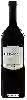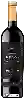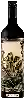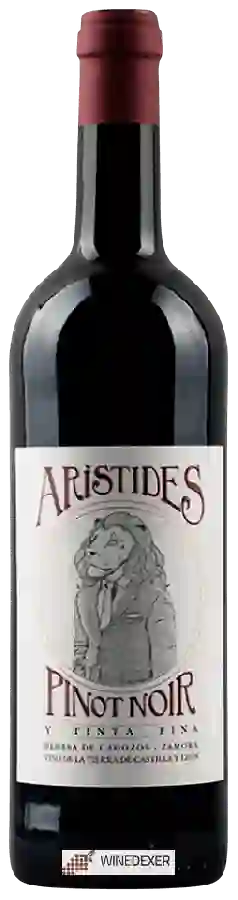
Winery Dehesa de CadozosArístides Pinot Noir y Tinta Fina
 Red wine


In the mouth this red wine is a powerful with a lot of tannins present in the mouth.
This wine generally goes well with poultry, beef or veal.
Taste structure of the Arístides Pinot Noir y Tinta Fina from the Winery Dehesa de Cadozos
Light | Bold | |
Smooth | Tannic | |
Dry | Sweet | |
Soft | Acidic |
In the mouth the Arístides Pinot Noir y Tinta Fina of Winery Dehesa de Cadozos in the region of Castille-et-Léon is a powerful with a lot of tannins present in the mouth.
Food and wine pairings with Arístides Pinot Noir y Tinta Fina
Pairings that work perfectly with Arístides Pinot Noir y Tinta Fina



Original food and wine pairings with Arístides Pinot Noir y Tinta Fina

The Arístides Pinot Noir y Tinta Fina of Winery Dehesa de Cadozos matches generally quite well with dishes of beef, pasta or veal such as recipes of american fillet (belgian-style beef tartar), fried rice noodles with chicken or stuffed veal breast.
Details and technical informations about Winery Dehesa de Cadozos's Arístides Pinot Noir y Tinta Fina.
Discover the grape variety: Pinot noir
Pinot noir is an important red grape variety in Burgundy and Champagne, and its reputation is well known! Great wines such as the Domaine de la Romanée Conti elaborate their wines from this famous grape variety, and make it a great variety. When properly vinified, pinot noit produces red wines of great finesse, with a wide range of aromas depending on its advancement (fruit, undergrowth, leather). it is also the only red grape variety authorized in Alsace. Pinot Noir is not easily cultivated beyond our borders, although it has enjoyed some success in Oregon, the United States, Australia and New Zealand.
Last vintages of this wine
The best vintages of Arístides Pinot Noir y Tinta Fina from Winery Dehesa de Cadozos are 2011, 0
Informations about the Winery Dehesa de Cadozos
The Winery Dehesa de Cadozos is one of of the world's greatest estates. It offers 3 wines for sale in the of Castille-et-Léon to come and discover on site or to buy online.

The wine region of Castille-et-Léon
Located in the northern half of the Central Iberian plateau, Castilla y León is the largest of Spain's 17 administrative regions, covering about one-fifth of the country's total area. It extends about 350 kilometres (220 miles) from central Spain to the northern coast. Just as wide, it connects the Rioja wine region to the Portuguese border. Red wines reign supreme in Castilla y León, and the Tempranillo grape is undoubtedly the king.
The word of the wine: Tanin
A natural compound contained in the skin of the grape, the seed or the woody part of the bunch, the stalk. The maceration of red wines allows the extraction of tannins, which give the texture, the solidity and also the mellowness when the tannins are "ripe". The winemaker seeks above all to extract the tannins from the skin, the ripest and most noble. The tannins of the seed or stalk, which are "greener", especially in average years, give the wine hardness and astringency. The wines of Bordeaux (based on Cabernet and Merlot) are full of tannins, those of Burgundy much less so, with Pinot Noir containing little.