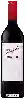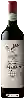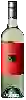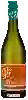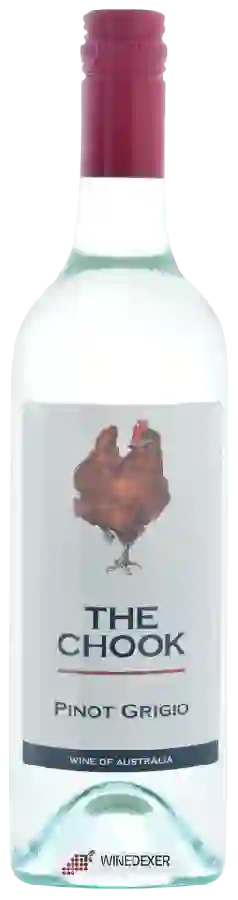
Winery The ChookPinot Grigio
 White wine
In the mouth this white wine is a .
This wine generally goes well with pork, cured meat or mushrooms.
Taste structure of the Pinot Grigio from the Winery The Chook
Light | Bold | |
Dry | Sweet | |
Soft | Acidic |
In the mouth the Pinot Grigio of Winery The Chook in the region of Australie du Sud is a .
Food and wine pairings with Pinot Grigio
Pairings that work perfectly with Pinot Grigio


Original food and wine pairings with Pinot Grigio

The Pinot Grigio of Winery The Chook matches generally quite well with dishes of pork, spicy food or mushrooms such as recipes of alsatian sauerkraut, pakistani rice (biryani) or pork tenderloin with apples and raw cider.
Details and technical informations about Winery The Chook's Pinot Grigio.
Discover the grape variety: Muresconu
Muresconu noir is a grape variety that originated in France (Corsica). It produces a variety of grape especially used for the elaboration of wine. It is rare to find this grape to eat on our tables. Muresconu noir can be found in several vineyards: South-West, Cognac, Bordeaux, Provence & Corsica, Rhone Valley, Loire Valley, Savoie & Bugey, Beaujolais.
Informations about the Winery The Chook
The Winery The Chook is one of of the world's greatest estates. It offers 4 wines for sale in the of Australie du Sud to come and discover on site or to buy online.

The wine region of Australie du Sud
SouthAustralia is one of Australia's six states, located (as the name suggests) in the south of the vast island continent. It's the engine room of the Australian wine industry, responsible for about half of the country's total production each year. But there's more to the region than quantity - countless high-quality wines are produced here, most from the region's signature Grape, Shiraz. These include such fine, collectible wines as Penfolds Grange, Henschke Hill of Grace, Torbreck The Laird and d'Arenberg The Dead Arm.
The word of the wine: Muscat blanc à petits grains
A white grape variety cultivated since antiquity on the shores of the Mediterranean, it is considered the noblest of the muscats. It is mainly used to make sweet wines, often from mutage. In France, it is the sole variety used in many natural sweet wines: muscat-de-frontignan, muscat-de-mireval, muscat-de-lunel, muscat-de-saint-jean-de-minervois, muscat-de-beaumes-de-venise, muscat-du-cap-corse. Combined with Muscat d'Alexandrie, it gives Muscat-de-Rivesaltes. It is also used to make sparkling white wines (clairette-de-die; moscato d'asti and asti spumante in Italy) and dry wines (alsace-muscat). Powerfully aromatic and complex, its wines evoke fresh grapes, roses, exotic fruits, citrus fruits and spices.