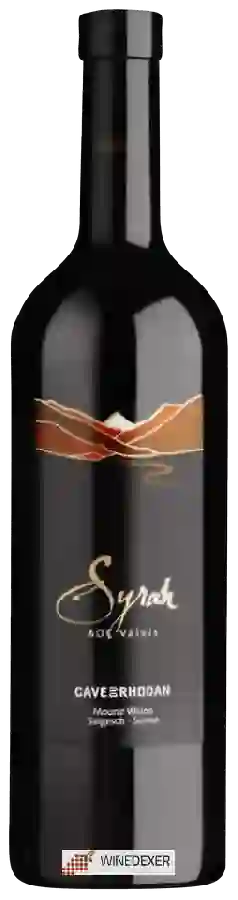
Cave du RhodanSyrah
 Red wine



In the mouth this red wine is a powerful with a nice freshness.
This wine generally goes well with poultry, beef or game (deer, venison).
The Syrah of the Cave du Rhodan is in the top 80 of wines of Salgesch.

Taste structure of the Syrah from the Cave du Rhodan
Light | Bold | |
Smooth | Tannic | |
Dry | Sweet | |
Soft | Acidic |
In the mouth the Syrah of Cave du Rhodan in the region of Valais is a powerful with a nice freshness.
Food and wine pairings with Syrah
Pairings that work perfectly with Syrah



Original food and wine pairings with Syrah

The Syrah of Cave du Rhodan matches generally quite well with dishes of beef, lamb or game (deer, venison) such as recipes of tata simone's dumplings, crusted lamb fillets with sweet spices or duck breast with red fruits.
Details and technical informations about Cave du Rhodan's Syrah.
Discover the grape variety: Admirable de Courtiller
Table grape with long clusters and juicy, crunchy golden berries with delicate sweet and muscat-tinged flavours and thin skin. Vinified in limited quantities, giving simple, fresh and lightly muscat-scented whites. Now rare, appreciated by enthusiasts and preserved in French ampelographic collections, listed in the official Catalogue on List A1. French table grape variety from a chasselas × bicane cross obtained around 1840 in Saumur by Dr Courtiller.
Last vintages of this wine
The best vintages of Syrah from Cave du Rhodan are 0
Informations about the Cave du Rhodan
The Cave du Rhodan is one of of the world's great estates. It offers 54 wines for sale in the of Salgesch to come and discover on site or to buy online.

The wine region of Salgesch
Wine commune of the Upper Valais (Switzerland), nicknamed the "Swiss capital of red wines". Pinot Noir flagship red: fine and silky with signature notes of red cherry, wild strawberry, raspberry, undergrowth, sweet spices and mineral touch, fine tannins and elegant palate — alpine expression. Supple Gamay, dense Cornalina (autochthonous), spicy Humagne rouge. Whites: taut Chasselas (Fendant), mineral and saline Petite Arvine, ancient Heida.
The wine region of Valais
Switzerland's largest vineyard, capital of native grapes. Straight, precise alpine whites: light, floral Chasselas (Fendant), signature Petite Arvine with saline, grapefruit and rhubarb notes, rich, apricoty Amigne, mineral Humagne Blanche. Altitude reds: fine Pinot Noir, crisp Gamay, native Cornalin and Humagne Rouge, spicy and deep. Highly precise alpine age-worthy wines.
The word of the wine: Côte des Blancs
One of the most famous terroirs of the Champagne region, from Épernay to Vertus, mainly devoted to Chardonnay, hence its name. The villages of Chouilly, Cramant, Cuis, Mesnil-sur-Oger, Avize, etc., lying on the chalk, are in a way to Champagne what Meursault, Chablis and Puligny are to Burgundy.