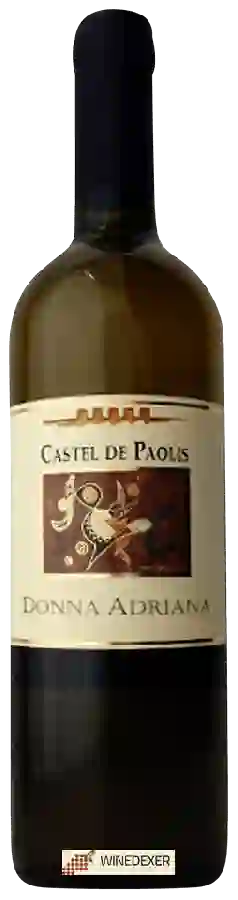
Winery Castel de PaolisDonna Adriana
 White wine



In the mouth this white wine is a powerful with a nice freshness.
This wine generally goes well with vegetarian, appetizers and snacks or lean fish.

Taste structure of the Donna Adriana from the Winery Castel de Paolis
Light | Bold | |
Dry | Sweet | |
Soft | Acidic |
In the mouth the Donna Adriana of Winery Castel de Paolis in the region of Lazio is a powerful with a nice freshness.
Food and wine pairings with Donna Adriana
Pairings that work perfectly with Donna Adriana



Original food and wine pairings with Donna Adriana


The Donna Adriana of Winery Castel de Paolis matches generally quite well with dishes of pasta, vegetarian or appetizers and snacks such as recipes of farfalle with gorgonzola, quiche without pastry, courgette and blue cheese or toast with foie gras and gingerbread.
Details and technical informations about Winery Castel de Paolis's Donna Adriana.
Discover the grape variety: Viognier
Opulent, heady whites, rich and silky, with intense aromas of apricot, yellow peach, mango, violet, honeysuckle and musky, honeyed notes. Discreet acidity, creamy finish. Star of Condrieu AOC and Château-Grillet AOC, co-vinified in Côte-Rôtie with Syrah (up to 20%). Widely exported to California (Central Coast), Australia (Eden Valley) and Languedoc. A Rhône variety.
Last vintages of this wine
The best vintages of Donna Adriana from Winery Castel de Paolis are 2013, 2017, 2014, 2015 and 0.
Informations about the Winery Castel de Paolis
The Winery Castel de Paolis is one of of the world's greatest estates. It offers 12 wines for sale in the of Lazio to come and discover on site or to buy online.

The wine region of Lazio
Two-millennia Roman vineyard, predominantly white on the volcanic soils of the Castelli Romani. Frascati DOC as figurehead: fresh, accessible whites based on Malvasia and Trebbiano, notes of green apple, white flowers and almond, slightly bitter finish. Also Bellone and Grechetto. Emblematic red: Cesanese del Piglio DOCG, fleshy with notes of ripe cherry, dry herbs and spice, round tannins.
The word of the wine: Muscat blanc à petits grains
A white grape variety cultivated since antiquity on the shores of the Mediterranean, it is considered the noblest of the muscats. It is mainly used to make sweet wines, often from mutage. In France, it is the sole variety used in many natural sweet wines: muscat-de-frontignan, muscat-de-mireval, muscat-de-lunel, muscat-de-saint-jean-de-minervois, muscat-de-beaumes-de-venise, muscat-du-cap-corse. Combined with Muscat d'Alexandrie, it gives Muscat-de-Rivesaltes. It is also used to make sparkling white wines (clairette-de-die; moscato d'asti and asti spumante in Italy) and dry wines (alsace-muscat). Powerfully aromatic and complex, its wines evoke fresh grapes, roses, exotic fruits, citrus fruits and spices.