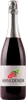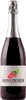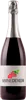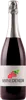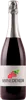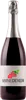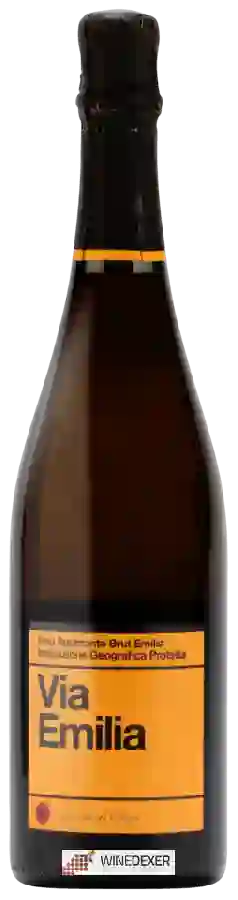
Winery Cantina di SorbaraVia Emilia Spumante Brut
 Sparkling wine



This wine generally goes well with
Details and technical informations about Winery Cantina di Sorbara's Via Emilia Spumante Brut.
Discover the grape variety: Arriloba
The white Arriloba is a grape variety that originated in . It produces a variety of grape specially used for the elaboration of wine. It is rare to find this grape to eat on our tables. This variety is characterized by medium-sized bunches and small grapes. White Arriloba can be found in several vineyards: South West, Cognac, Bordeaux, Loire Valley, Provence & Corsica, Languedoc & Roussillon, Rhone Valley, Armagnac.
Last vintages of this wine
The best vintages of Via Emilia Spumante Brut from Winery Cantina di Sorbara are 2018, 2017, 0
Informations about the Winery Cantina di Sorbara
The Winery Cantina di Sorbara is one of of the world's great estates. It offers 61 wines for sale in the of Emilia to come and discover on site or to buy online.

The wine region of Emilia
The wine region of Emilia is located in the region of Émilie-Romagne of Italy. We currently count 397 estates and châteaux in the of Emilia, producing 1004 different wines in conventional, organic and biodynamic agriculture. The wines of Emilia go well with generally quite well with dishes .
The wine region of Emilia-Romagna
Romagna/emilia">Emilia-Romagna is a Rich and fertile region in Northern Italy, and one of the country's most prolific wine-producing regions, with over 58,000 hectares (143,320 acres) of vines in 2010. It is 240 kilometers (150 miles) wide and stretches across almost the entire northern Italian peninsula, sandwiched between Tuscany to the South, Lombardy and Veneto to the north and the Adriatic Sea to the east. Nine miles of Liguria is all that separates Emilia-Romagna from the Ligurian Sea, and its uniqueness as the only Italian region with both an east and west coast. Emilia-Romagna's wine-growing heritage dates back to the seventh century BC, making it one of the oldest wine-growing regions in Italy.
The word of the wine: Tanin
A natural compound contained in the skin of the grape, the seed or the woody part of the bunch, the stalk. The maceration of red wines allows the extraction of tannins, which give the texture, the solidity and also the mellowness when the tannins are "ripe". The winemaker seeks above all to extract the tannins from the skin, the ripest and most noble. The tannins of the seed or stalk, which are "greener", especially in average years, give the wine hardness and astringency. The wines of Bordeaux (based on Cabernet and Merlot) are full of tannins, those of Burgundy much less so, with Pinot Noir containing little.