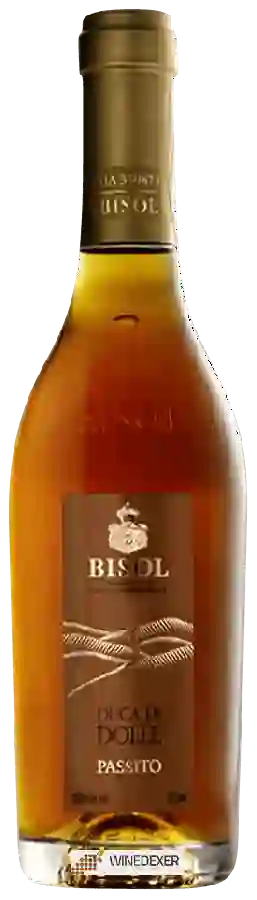
Winery BisolDuca di Dolle Passito
 Sweet wine


This wine generally goes well with appetizers and snacks, rich fish (salmon, tuna etc) or shellfish.
Food and wine pairings with Duca di Dolle Passito
Pairings that work perfectly with Duca di Dolle Passito



Original food and wine pairings with Duca di Dolle Passito


The Duca di Dolle Passito of Winery Bisol matches generally quite well with dishes of rich fish (salmon, tuna etc), shellfish or mature and hard cheese such as recipes of cream and tuna quiche, paella from an old spanish grandmother... or vegetarian quiche with mushrooms and comté cheese.
Details and technical informations about Winery Bisol's Duca di Dolle Passito.
Discover the grape variety: Ahmeur bou A(h)meur
Its origin would be from North Africa (Algeria/Kabylie) or Spain. It is a variety that was often grown on trellises in front of houses and sometimes its grapes were preserved in brandy to be enjoyed throughout the year. It is found in North Africa, the United States (California), Argentina, Spain and Portugal. In France, it is not well known because of its susceptibility to winter frosts and its late ripening.
Last vintages of this wine
The best vintages of Duca di Dolle Passito from Winery Bisol are 0
Informations about the Winery Bisol
The Winery Bisol is one of of the world's great estates. It offers 32 wines for sale in the of Veneto to come and discover on site or to buy online.

The wine region of Veneto
Veneto is an important and growing wine region in northeastern Italy. Veneto is administratively Part of the Triveneto area, aLong with its smaller neighbors, Trentino-Alto Adige and Friuli-Venezia Giulia. In terms of geography, culture and wine styles, it represents a transition from the Alpine and Germanic-Slavic end of Italy to the warmer, drier, more Roman lands to the South. Veneto is slightly smaller than the other major Italian wine regions - Piedmont, Tuscany, Lombardy, Puglia and Sicily - but it produces more wine than any of them.
The word of the wine: Terroir
Strictly speaking, the notion of terroir corresponds to the geological characteristics of a vineyard. However, when we talk about terroir, we take into account the soil, the climate (even the microclimate), the flora, the fauna, and the human factor that characterizes the practices that make up the art of the craft.