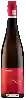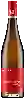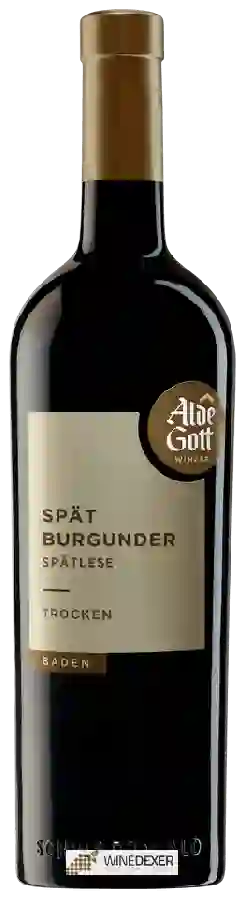
Winery Alde GottSpätburgunder Spätlese Trocken
 Red wine



In the mouth this red wine is a with a nice freshness.
This wine generally goes well with poultry, beef or veal.

Taste structure of the Spätburgunder Spätlese Trocken from the Winery Alde Gott
Light | Bold | |
Smooth | Tannic | |
Dry | Sweet | |
Soft | Acidic |
In the mouth the Spätburgunder Spätlese Trocken of Winery Alde Gott in the region of Baden is a with a nice freshness.
Wine flavors and olphactive analysis




On the nose the Spätburgunder Spätlese Trocken of Winery Alde Gott in the region of Baden often reveals types of flavors of oaky, smoke or strawberries and sometimes also flavors of raspberry, non oak or earth.
Food and wine pairings with Spätburgunder Spätlese Trocken
Pairings that work perfectly with Spätburgunder Spätlese Trocken



Original food and wine pairings with Spätburgunder Spätlese Trocken

The Spätburgunder Spätlese Trocken of Winery Alde Gott matches generally quite well with dishes of beef, veal or game (deer, venison) such as recipes of autumn beef bourguignon, roast veal with milk and rosemary or duck breast with honey, potato and onion with garlic.
Details and technical informations about Winery Alde Gott's Spätburgunder Spätlese Trocken.
Discover the grape variety: Verdeca
Lively, refreshing whites with a pale robe, lean palate and fresh acidity. Delicate aromas of citrus (lemon, grapefruit), green apple, white flowers, fresh almond and saline mineral notes. Light finish, best drunk young. Star of Locorotondo DOC and Martina Franca DOC in the Itria Valley at the heart of Puglia; long used for vermouths. Native Apulian variety, identical to the Greek Lagorthi according to recent DNA analysis.
Last vintages of this wine
The best vintages of Spätburgunder Spätlese Trocken from Winery Alde Gott are 2015, 2017, 2016, 2012
Informations about the Winery Alde Gott
The Winery Alde Gott is one of of the world's greatest estates. It offers 80 wines for sale in the of Baden to come and discover on site or to buy online.

The wine region of Baden
German capital of Pinot Noir (Spätburgunder): silky, fine reds with notes of red fruits, cherry, undergrowth and sweet spices, melted tannins. Round Grauburgunder (Pinot Gris), lively Weissburgunder, supple Müller-Thurgau, mineral Riesling. Germany's 3rd region (15,000 ha) in Baden-Württemberg facing Alsace, one of the country's warmest climates, volcanic soils at the Kaiserstuhl. Cradle of modern great German reds, elegant and fine.
The word of the wine: Approval
All the operations (tasting and analysis) that allow the appellation to be obtained for each of the wines of a property, for each vintage.