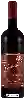
Weingut WolfCabernet Sauvignon Trocken
 Red wine
This wine generally goes well with poultry, beef or lamb.
Food and wine pairings with Cabernet Sauvignon Trocken
Pairings that work perfectly with Cabernet Sauvignon Trocken



Original food and wine pairings with Cabernet Sauvignon Trocken

The Cabernet Sauvignon Trocken of Weingut Wolf matches generally quite well with dishes of beef, lamb or spicy food such as recipes of dombrés and pig tails, lamb with masalé sauce and rice or genuine chicken tagine olive and lemon confit tagine with argan oil.
Details and technical informations about Weingut Wolf's Cabernet Sauvignon Trocken.
Discover the grape variety: Cabernet-Sauvignon
Cabernet-Sauvignon noir is a grape variety that originated in France (Bordeaux). It produces a variety of grape specially used for wine making. It is rare to find this grape to eat on our tables. This variety of grape is characterized by small bunches, and small grapes. Cabernet-Sauvignon noir can be found in many vineyards: South-West, Loire Valley, Languedoc & Roussillon, Cognac, Bordeaux, Armagnac, Rhone Valley, Provence & Corsica, Savoie & Bugey, Beaujolais.
Informations about the Weingut Wolf
The Weingut Wolf is one of of the world's greatest estates. It offers 29 wines for sale in the of Rheinhessen to come and discover on site or to buy online.

The wine region of Rheinhessen
Rheinhessen is Germany's largest region for producing the quality wines of the Qualitätswein bestimmter Anbaugebiete (QbA) and Prädikatswein designations, with roughly 26,500 hectares (65,000 acres) of Vineyard">Vineyards as of 2014. Many of its most significant viticultural areas are favorably influenced by the Rhine river, which runs aLong its North and eastern borders. The Rhine, along with the Nahe river to the west and the Haardt mountains to its South, form a natural border. Rheinhessen covers an area south of Rheingau, north of Pfalz and east of Nahe, and is located within the Rhineland-Palatinate federal state.
The word of the wine: Premier cru
In Burgundy, third level of classification (above the regional and communal appellations), designating the wines produced on delimited parcels (climats) whose name is added to the communal appellation. The climats classified as first growths are 635.