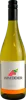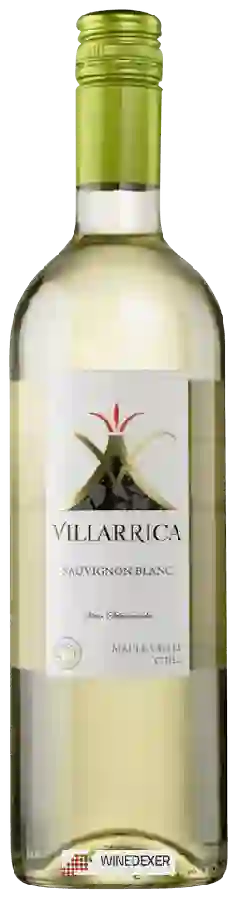
Winery VillarricaSauvignon Blanc
 White wine



In the mouth this white wine is a powerful with a nice freshness.
This wine generally goes well with vegetarian, shellfish or goat cheese.
Taste structure of the Sauvignon Blanc from the Winery Villarrica
Light | Bold | |
Dry | Sweet | |
Soft | Acidic |
In the mouth the Sauvignon Blanc of Winery Villarrica in the region of Central Valley is a powerful with a nice freshness.
Wine flavors and olphactive analysis

On the nose the Sauvignon Blanc of Winery Villarrica in the region of Central Valley often reveals types of flavors of citrus fruit, floral.
Food and wine pairings with Sauvignon Blanc
Pairings that work perfectly with Sauvignon Blanc


Original food and wine pairings with Sauvignon Blanc
The Sauvignon Blanc of Winery Villarrica matches generally quite well with dishes of shellfish, vegetarian or goat cheese such as recipes of scallops on a bed of leeks, salmon and goat cheese quiche or peach and apricot chicken (about 270 calories).
Details and technical informations about Winery Villarrica's Sauvignon Blanc.
Discover the grape variety: Fel
Most likely from southwest France, found in Aveyron at Estaing and around Marcillac.
Last vintages of this wine
The best vintages of Sauvignon Blanc from Winery Villarrica are 2017, 2015, 0, 2018
Informations about the Winery Villarrica
The Winery Villarrica is one of of the world's greatest estates. It offers 5 wines for sale in the of Maule Valley to come and discover on site or to buy online.

The wine region of Maule Valley
Maule Valley is the largest wine-producing region in Chile other than the Central Valley, of which it is a Part. It has 75,000 acres (30,000ha) under Vine, and has traditionally been associated with quantity rather than quality. But this is rapidly changing – the bulk-producing Pais vine is gradually being replaced with more international varieties such as Cabernet Sauvignon and Carmenère, and careful winemaking practices are being employed to make some world-class red wines from old-vine Carignan. The Central Valley itself runs between the Andes and the Coastal Mountains from the Chilean capital of Santiago in the North to the up-and-coming region of Bío Bío in the South.
The wine region of Central Valley
The Central Valley (El Valle Central) of Chile is one of the most important wine-producing areas in South America in terms of Volume. It is also one of the largest wine regions, stretching from the Maipo Valley (just south of Santiago) to the southern end of the Maule Valley. This is a distance of almost 250 miles (400km) and covers a number of Climate types. The Central Valley wine region is easily (and often) confused with the geological Central Valley, which runs north–south for more than 620 miles (1000km) between the Pacific Coastal Ranges and the lower Andes.
The word of the wine: Elegant
Said of a wine that, beyond balance, presents qualities of charm and harmony, without the slightest heaviness.