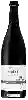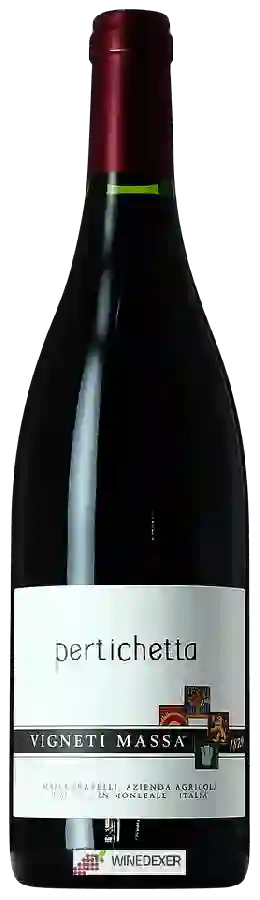
Winery Vigneti MassaPertichetta Croatina
 Red wine


In the mouth this red wine is a powerful with a lot of tannins present in the mouth.
This wine generally goes well with beef, game (deer, venison) or lamb.
Taste structure of the Pertichetta Croatina from the Winery Vigneti Massa
Light | Bold | |
Smooth | Tannic | |
Dry | Sweet | |
Soft | Acidic |
In the mouth the Pertichetta Croatina of Winery Vigneti Massa in the region of Piedmont is a powerful with a lot of tannins present in the mouth.
Wine flavors and olphactive analysis





On the nose the Pertichetta Croatina of Winery Vigneti Massa in the region of Piedmont often reveals types of flavors of non oak, earth or oak and sometimes also flavors of spices, red fruit or black fruit.
Food and wine pairings with Pertichetta Croatina
Pairings that work perfectly with Pertichetta Croatina



Original food and wine pairings with Pertichetta Croatina

The Pertichetta Croatina of Winery Vigneti Massa matches generally quite well with dishes of beef, pasta or lamb such as recipes of pork tongue with bacon and onions, tagliatelle with carbonara or mouse of lamb with honey and thyme.
Details and technical informations about Winery Vigneti Massa's Pertichetta Croatina.
Discover the grape variety: Cabernet franc
Cabernet Franc is one of the oldest red grape varieties in Bordeaux. The Libourne region is its terroir where it develops best. The terroirs of Saint-Emilion and Fronsac allow it to mature and develop its best range of aromas. It is also the majority in many blends. The very famous Château Cheval Blanc, for example, uses 60% Cabernet Franc. The wines produced with Cabernet Franc are medium in colour with fine tannins and subtle aromas of small red fruits and spices. When blended with Merlot and Cabernet Sauvignon, it brings complexity and a bouquet of aromas to the wine. It produces fruity wines that can be drunk quite quickly, but whose great vintages can be kept for a long time. It is an earlier grape variety than Cabernet Sauvignon, which means that it is planted as far north as the Loire Valley. In Anjou, it is also used to make sweet rosé wines. Cabernet Franc is now used in some twenty countries in Europe and throughout the world.
Last vintages of this wine

The best vintages of Pertichetta Croatina from Winery Vigneti Massa are 2013, 2012, 2010, 2006 and 2007.
Informations about the Winery Vigneti Massa
The Winery Vigneti Massa is one of of the world's greatest estates. It offers 29 wines for sale in the of Colli Tortonesi to come and discover on site or to buy online.

The wine region of Colli Tortonesi
The wine region of Colli Tortonesi is located in the region of Piémont of Italy. Wineries and vineyards like the Domaine Vigneti Massa or the Domaine Vigneti Massa produce mainly wines red, white and sparkling. The most planted grape varieties in the region of Colli Tortonesi are Cortese, Freisa and Merlot, they are then used in wines in blends or as a single variety. On the nose of Colli Tortonesi often reveals types of flavors of cream, mushroom or black cherries and sometimes also flavors of plum, jam or leather.
The wine region of Piedmont
Piedmont (Piemonte) holds an unrivalled place among the world's finest wine regions. Located in northwestern Italy, it is home to more DOCG wines than any other Italian region, including such well-known and respected names as Barolo, Barbaresco and Barbera d'Asti. Though famous for its Austere, Tannic, Floral">floral reds made from Nebbiolo, Piedmont's biggest success story in the past decade has been Moscato d'Asti, a Sweet, Sparkling white wine. Piedmont Lies, as its name suggests, at the foot of the Western Alps, which encircle its northern and western sides and form its naturally formidable border with Provence, France.
The word of the wine: Maceration
Prolonged contact and exchange between the juice and the grape solids, especially the skin. Not to be confused with the time of fermentation, which follows maceration. The juice becomes loaded with colouring matter and tannins, and acquires aromas. For a rosé, the maceration is short so that the colour does not "rise" too much. For white wines too, a "pellicular maceration" can be practised, which allows the wine to acquire more fat.