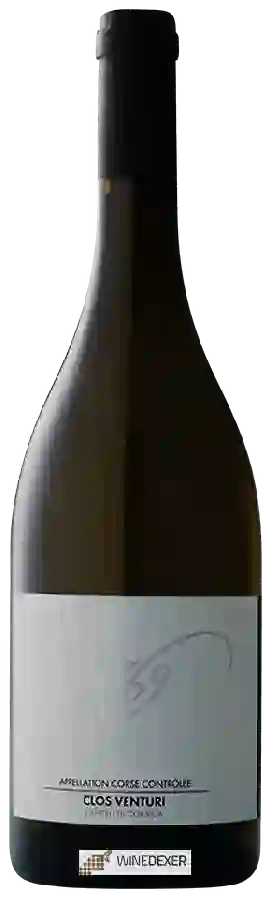
Domaine Vico1769 Clos Venturi Blanc
 White wine


In the mouth this white wine is a with a nice freshness.
This wine generally goes well with lean fish, shellfish or mild and soft cheese.
Taste structure of the 1769 Clos Venturi Blanc from the Domaine Vico
Light | Bold | |
Dry | Sweet | |
Soft | Acidic |
In the mouth the 1769 Clos Venturi Blanc of Domaine Vico in the region of Corsica is a with a nice freshness.
Wine flavors and olphactive analysis






On the nose the 1769 Clos Venturi Blanc of Domaine Vico in the region of Corsica often reveals types of flavors of grapefruit, green apple or cheese and sometimes also flavors of earth, microbio or vegetal.
Food and wine pairings with 1769 Clos Venturi Blanc
Pairings that work perfectly with 1769 Clos Venturi Blanc



Original food and wine pairings with 1769 Clos Venturi Blanc
The 1769 Clos Venturi Blanc of Domaine Vico matches generally quite well with dishes of shellfish, lean fish or mild and soft cheese such as recipes of fish fondue, back of cod, beurre blanc with tarragon or homemade pizza crunch.
Details and technical informations about Domaine Vico's 1769 Clos Venturi Blanc.
Discover the grape variety: Vermentino
The vermentino grape variety was widespread in Italy, Sardinia and Corsica. Today, Vermentino is grown in the regions bordering the Mediterranean, mainly in Provence (Côtes de Provence, Bellet), Corsica (Corse Calvi), Languedoc (Côtes du Roussillon, Costières de Nîmes) and the Rhône Valley (Côtes du Luberon). Because it ripens late, Vermentino requires a warm climate for its development and can only be grown in regions with good sun exposure. Conversely, cold or temperate climates do not allow it to ripen properly. Vermentino is only susceptible to powdery mildew. When vinified on its own, Vermentino produces a single-variety dry white wine that is light and full-bodied with a pale yellow color. It can also be blended with other grape varieties such as Ugni Blanc, Cinsault and Grenache, in which case its low acidity makes it light and fresh. Vermentino belongs to the grape varieties of Ajaccio, Corsica and Corbières. The aromas released by this variety are multiple. One can detect notes of fresh apple, green almond, sweet spices, hawthorn, ripe pear and fresh pineapple.
Last vintages of this wine

The best vintages of 1769 Clos Venturi Blanc from Domaine Vico are 2017, 2024, 2022, 2020 and 2015.
Informations about the Domaine Vico
The Domaine Vico is one of of the world's greatest estates. It offers 52 wines for sale in the of Vin de Corse to come and discover on site or to buy online.

The wine region of Vin de Corse
Regional AOC covering the Île de Beauté outside the communal AOCs, Mediterranean climate on granite and schist. Signature native trio. Niellucciu as deep red (cousin of Sangiovese): black cherry, blackberry, garrigue, maquis, leather and spices, firm tannins. Sciaccarellu as fine peppery red (strawberry, pepper, herbs), also great rosé.
The wine region of Corsica
Mediterranean island wine region with a triple native face, ~8,000 ha. Niellucciu signature (cousin of Sangiovese) dominates Patrimonio: structured reds with signature notes of black cherry, garrigue, maquis, spices and leather, firm tannins and sun-drenched mouth. Sciaccarellu (min. 60% in Ajaccio) lighter and peppery (strawberry, wild herbs).
The word of the wine: Heida
See savagnin.