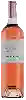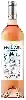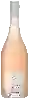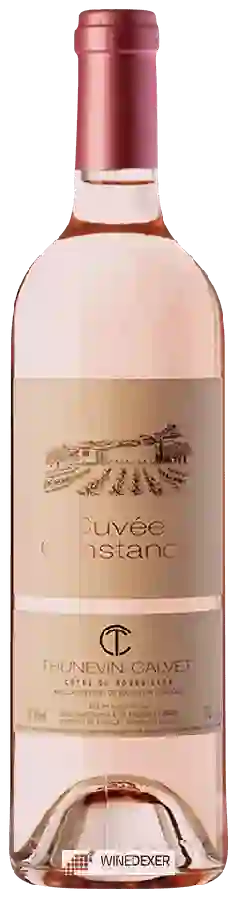
Winery Thunevin-CalvetCuvée Constance Rosé
 Pink wine


In the mouth this pink wine is a powerful with a nice freshness.
This wine generally goes well with vegetarian, appetizers and snacks or lean fish.

Taste structure of the Cuvée Constance Rosé from the Winery Thunevin-Calvet
Light | Bold | |
Dry | Sweet | |
Soft | Acidic |
In the mouth the Cuvée Constance Rosé of Winery Thunevin-Calvet in the region of Languedoc-Roussillon is a powerful with a nice freshness.
Wine flavors and olphactive analysis

Food and wine pairings with Cuvée Constance Rosé
Pairings that work perfectly with Cuvée Constance Rosé



Original food and wine pairings with Cuvée Constance Rosé


The Cuvée Constance Rosé of Winery Thunevin-Calvet matches generally quite well with dishes of pasta, vegetarian or appetizers and snacks such as recipes of lasagna with pointed cabbage, quiche with bacon and gruyère cheese or avocado verrine and quick.
Details and technical informations about Winery Thunevin-Calvet's Cuvée Constance Rosé.
Discover the grape variety: Mornen
Light and fruity reds with a clear ruby colour, smooth tannins, an airy palate with preserved acidity, and aromas of red fruits (raspberry) with discreet peppery notes. Rustic Rhône Valley profile. Preserved for its heritage value, surviving in a few patrimonial plots in Ardèche; studied for its ampelographic interest. Native French black variety, formerly grown in Ardèche and the Rhône Valley.
Informations about the Winery Thunevin-Calvet
The Winery Thunevin-Calvet is one of of the world's great estates. It offers 20 wines for sale in the of Côtes du Roussillon to come and discover on site or to buy online.

The wine region of Côtes du Roussillon
Catalan sun and Mediterranean character on the edge of the Pyrenees. Fleshy, sun-soaked reds with signature notes of candied black fruit (blackberry, plum), garrigue, pepper, liquorice and dark chocolate, firm tannins and generous warmth. Blends of Grenache (roundness), Syrah (spice), old-vine Carignan (power) and dense Mourvèdre. Also sunny rosés and ample whites (Grenache Blanc, Macabeu).
The wine region of Languedoc-Roussillon
Largest single French vineyard, dominated by sunny, generous reds. Spicy Syrah, candied Grenache (ripe fruit, garrigue), structured Carignan, deep Mourvèdre, supple Cinsault. Stars: structured Corbières, Minervois, Faugères, Saint-Chinian; round Côtes-du-Roussillon. Legendary vins doux naturels: Banyuls and Maury (fortified Grenache) with notes of cocoa, fig, prune.
The word of the wine: Pinot meunier
Cultivated in the 19th century in all the northern vineyards, this black grape variety has largely regressed since. Very present in the Marne valley, it constitutes a third of the vineyards in Champagne, alongside pinot noir and chardonnay with which it is often blended. It brings roundness and red and yellow fruit aromas to champagnes. Pinot meunier is also the dominant grape variety in red and rosé wines in the Orleans AOC and the rare Touraine-Noble-Joué, a grey wine. Syn.: meunier.