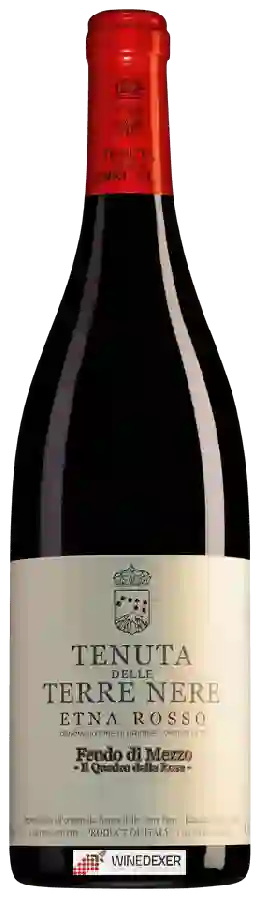
Winery Tenuta delle Terre NereEtna Feudo di Mezzo Il Quadro Delle Rose Rosso
 Red wine


This wine is composed of 100% of the grape variety Nerello Mascalese.
In the mouth this red wine is a powerful with a lot of tannins present in the mouth.
This wine generally goes well with beef, lamb or pasta.
The Etna Feudo di Mezzo Il Quadro Delle Rose Rosso of the Winery Tenuta delle Terre Nere is in the top 20 of wines of Etna.
Taste structure of the Etna Feudo di Mezzo Il Quadro Delle Rose Rosso from the Winery Tenuta delle Terre Nere
Light | Bold | |
Smooth | Tannic | |
Dry | Sweet | |
Soft | Acidic |
In the mouth the Etna Feudo di Mezzo Il Quadro Delle Rose Rosso of Winery Tenuta delle Terre Nere in the region of Sicily is a powerful with a lot of tannins present in the mouth.
Wine flavors and olphactive analysis






On the nose the Etna Feudo di Mezzo Il Quadro Delle Rose Rosso of Winery Tenuta delle Terre Nere in the region of Sicily often reveals types of flavors of non oak, earth or microbio and sometimes also flavors of vegetal, oak or spices.
Food and wine pairings with Etna Feudo di Mezzo Il Quadro Delle Rose Rosso
Pairings that work perfectly with Etna Feudo di Mezzo Il Quadro Delle Rose Rosso



Original food and wine pairings with Etna Feudo di Mezzo Il Quadro Delle Rose Rosso
The Etna Feudo di Mezzo Il Quadro Delle Rose Rosso of Winery Tenuta delle Terre Nere matches generally quite well with dishes of beef, pasta or lamb such as recipes of kamounia : tunisian beef stew, pasta with 4 cheese sauce or ghormeh sabzi (iranian herbed lamb stew).
Details and technical informations about Winery Tenuta delle Terre Nere's Etna Feudo di Mezzo Il Quadro Delle Rose Rosso.
Discover the grape variety: Nerello mascalese
A very old grape variety grown in Italy, more precisely in the north of Sicily on the slopes of Mount Etna and in Sardinia. Its origin would be Greek because it was reported in Greece in the 7th century B.C. It is the result of a natural intraspecific crossing between sangiovese or nielluccio and mantonico bianco. It should not be confused with nerello capuccio and pignatello nero. It should be noted that Nerello mascalese seems to be a grape variety adapted to altitude, as is the case in Sicily where it is planted at a rate of 6,000 and 9,000 vines per hectare. It is practically unknown in other wine-producing countries, which is certainly due to its late ripening.
Last vintages of this wine

The best vintages of Etna Feudo di Mezzo Il Quadro Delle Rose Rosso from Winery Tenuta delle Terre Nere are 2006, 2018, 2017, 2014 and 2015.
Informations about the Winery Tenuta delle Terre Nere
The Winery Tenuta delle Terre Nere is one of of the world's greatest estates. It offers 18 wines for sale in the of Etna to come and discover on site or to buy online.

The wine region of Etna
The wine region of Etna is located in the region of Sicile of Italy. Wineries and vineyards like the Domaine Tenuta delle Terre Nere or the Domaine Gambino Vini produce mainly wines red, white and pink. The most planted grape varieties in the region of Etna are Nerello mascalese, Carricante and Nero d'Avola, they are then used in wines in blends or as a single variety. On the nose of Etna often reveals types of flavors of cherry, lime or new leather and sometimes also flavors of maraschino cherry, slate or crushed gravel.
The wine region of Sicily
Sicily is the Southernmost region of Italy, and the largest island in the Mediterranean Sea. For over 2500 years, Sicily (Sicilia in Italian) has been an important centre of Mediterranean viticulture, although the reputation and style of its wines have changed considerably over time. The island was once best known for its Sweet muscatels (see Pantelleria), and later for its fortified Marsala. Today, many of its best-known wines are Dry table wines produced under the regional designation IGT Terre Siciliane, or Sicilia DOC (see below).
The word of the wine: Sirupy
Close to the sensation of unctuousness, said of a wine that gives the impression of having the consistency of a syrup.