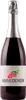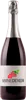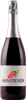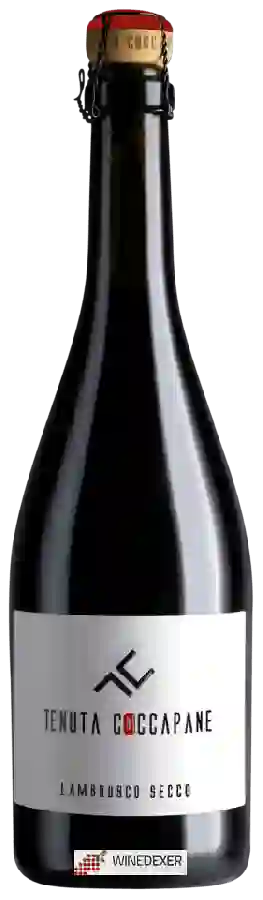
Winery Tenuta CoccapaneLambrusco Secco
 Sparkling wine



This wine generally goes well with pork, poultry or rich fish (salmon, tuna etc).
Food and wine pairings with Lambrusco Secco
Pairings that work perfectly with Lambrusco Secco



Original food and wine pairings with Lambrusco Secco


The Lambrusco Secco of Winery Tenuta Coccapane matches generally quite well with dishes of pork, rich fish (salmon, tuna etc) or mature and hard cheese such as recipes of quiche with mixed vegetables, sea bass wrapped in salt crust or old-fashioned aligot.
Details and technical informations about Winery Tenuta Coccapane's Lambrusco Secco.
Discover the grape variety: Vermentino
The vermentino grape variety was widespread in Italy, Sardinia and Corsica. Today, Vermentino is grown in the regions bordering the Mediterranean, mainly in Provence (Côtes de Provence, Bellet), Corsica (Corse Calvi), Languedoc (Côtes du Roussillon, Costières de Nîmes) and the Rhône Valley (Côtes du Luberon). Because it ripens late, Vermentino requires a warm climate for its development and can only be grown in regions with good sun exposure. Conversely, cold or temperate climates do not allow it to ripen properly. Vermentino is only susceptible to powdery mildew. When vinified on its own, Vermentino produces a single-variety dry white wine that is light and full-bodied with a pale yellow color. It can also be blended with other grape varieties such as Ugni Blanc, Cinsault and Grenache, in which case its low acidity makes it light and fresh. Vermentino belongs to the grape varieties of Ajaccio, Corsica and Corbières. The aromas released by this variety are multiple. One can detect notes of fresh apple, green almond, sweet spices, hawthorn, ripe pear and fresh pineapple.
Last vintages of this wine
The best vintages of Lambrusco Secco from Winery Tenuta Coccapane are 0
Informations about the Winery Tenuta Coccapane
The Winery Tenuta Coccapane is one of of the world's greatest estates. It offers 11 wines for sale in the of Emilia-Romagna to come and discover on site or to buy online.

The wine region of Emilia-Romagna
Romagna/emilia">Emilia-Romagna is a Rich and fertile region in Northern Italy, and one of the country's most prolific wine-producing regions, with over 58,000 hectares (143,320 acres) of vines in 2010. It is 240 kilometers (150 miles) wide and stretches across almost the entire northern Italian peninsula, sandwiched between Tuscany to the South, Lombardy and Veneto to the north and the Adriatic Sea to the east. Nine miles of Liguria is all that separates Emilia-Romagna from the Ligurian Sea, and its uniqueness as the only Italian region with both an east and west coast. Emilia-Romagna's wine-growing heritage dates back to the seventh century BC, making it one of the oldest wine-growing regions in Italy.
The word of the wine: Flexible
A tender wine with little tannin.