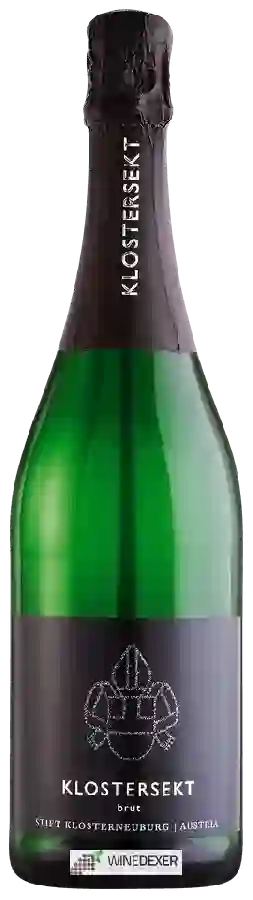
Winery Stiftskellerei KlosterneuburgKlostersekt Brut
 Sparkling wine



This wine generally goes well with pork, vegetarian or lean fish.
Food and wine pairings with Klostersekt Brut
Pairings that work perfectly with Klostersekt Brut



Original food and wine pairings with Klostersekt Brut



The Klostersekt Brut of Winery Stiftskellerei Klosterneuburg matches generally quite well with dishes of pork, rich fish (salmon, tuna etc) or shellfish such as recipes of braised (green) cabbage, fresh salmon risotto or fried squid.
Details and technical informations about Winery Stiftskellerei Klosterneuburg's Klostersekt Brut.
Discover the grape variety: Petit Bouschet
Crossbreeding carried out in 1829 by Louis Bouschet de Bernard (father of Henri Bouschet, also known for his numerous varieties) between the aramon and the teinturier. It was practically multiplied all over the world. Today, it is an extinct grape variety and can only be found in a few private or public collections and conservatories.
Last vintages of this wine
The best vintages of Klostersekt Brut from Winery Stiftskellerei Klosterneuburg are 2016, 0
Informations about the Winery Stiftskellerei Klosterneuburg
The Winery Stiftskellerei Klosterneuburg is one of of the world's great estates. It offers 52 wines for sale in the of Niederösterreich to come and discover on site or to buy online.

The wine region of Niederösterreich
Niederösterreich, or Lower Austria, is a wine region in the Northeast of Austria bordering Slovakia and the Czech Republic. It is the country's largest wine region, both geographically and in terms of production. There are around 28,000 hectares (69,000 acres) of vineyards. These are responsible for roughly half of Austria's total wine output.
The wine region of Weinland
Weinviertel DAC – whose name translates as "wine quarter" – is an appellation in Niederösterreich (Lower Austria). It is by far the largest Districtus Austriae Controllatus wine region in Austria. It was also the first Austrian wine region to be given that title, in 2002, with a DAC Reserve designation added in 2009. The designation applies only to white wines from the Grüner Veltliner Grape variety.
The word of the wine: Hygrometry
Humidity level of the cellar necessary for a good ageing of the wines. The recommended hygrometry is around 70% in order to guarantee a good elasticity of the corks while preserving the labels.