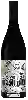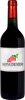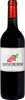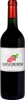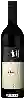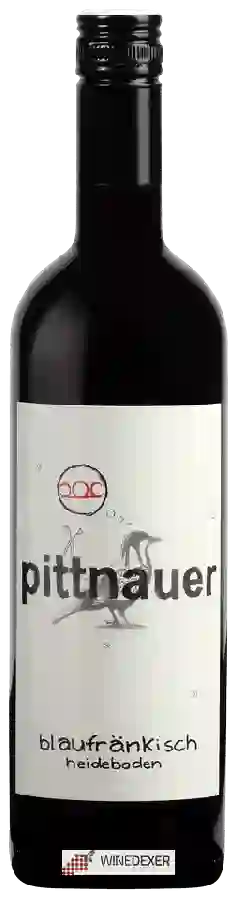
Winery PittnauerHeideboden Blaufränkisch
 Red wine



In the mouth this red wine is a powerful with a nice balance between acidity and tannins.
This wine generally goes well with poultry, beef or pasta.
Taste structure of the Heideboden Blaufränkisch from the Winery Pittnauer
Light | Bold | |
Smooth | Tannic | |
Dry | Sweet | |
Soft | Acidic |
In the mouth the Heideboden Blaufränkisch of Winery Pittnauer in the region of Weinland is a powerful with a nice balance between acidity and tannins.
Wine flavors and olphactive analysis



On the nose the Heideboden Blaufränkisch of Winery Pittnauer in the region of Weinland often reveals types of flavors of non oak, earth or oak and sometimes also flavors of spices, red fruit or black fruit.
Food and wine pairings with Heideboden Blaufränkisch
Pairings that work perfectly with Heideboden Blaufränkisch



Original food and wine pairings with Heideboden Blaufränkisch
The Heideboden Blaufränkisch of Winery Pittnauer matches generally quite well with dishes of beef, pasta or poultry such as recipes of braised beef with carrots, pasta with artichoke hearts and bacon or potato cakes.
Details and technical informations about Winery Pittnauer's Heideboden Blaufränkisch.
Discover the grape variety: Seinoir
Seinoir noir is a grape variety that originated in . This grape variety is the result of a cross between the same species (interspecific hybridization). It produces a variety of grape specially used for wine making. It is rare to find this grape to eat on our tables. The Seinoir noir can be found cultivated in the following vineyards: Provence & Corsica, Rhône Valley, Loire Valley, Savoie & Bugey, Beaujolais.
Last vintages of this wine
The best vintages of Heideboden Blaufränkisch from Winery Pittnauer are 2016, 2015, 2012, 2013 and 0.
Informations about the Winery Pittnauer
The Winery Pittnauer is one of of the world's great estates. It offers 33 wines for sale in the of Burgenland to come and discover on site or to buy online.

The wine region of Burgenland
Burgenland is a large wine-producing region on the eastern border of Austria. Despite the country's image as the producer of some of the world's finest white wines, Austria is also home to a thriving red wine culture: Burgenland, with its sunny, continental summers, is the country's key red wine region, with its wines based mainly on the Blaufränkisch and Zweigelt grape varieties. Sweet, botrytized wines are also a specialty of the region, particularly in the Terroir surrounding the Neusiedlersee lake. The region occupies a narrow strip of land that runs from the Danube River down to Steiermark in the South.
The wine region of Weinland
Weinviertel DAC – whose name translates as "wine quarter" – is an appellation in Niederösterreich (Lower Austria). It is by far the largest Districtus Austriae Controllatus wine region in Austria. It was also the first Austrian wine region to be given that title, in 2002, with a DAC Reserve designation added in 2009. The designation applies only to white wines from the Grüner Veltliner Grape variety.
The word of the wine: Viscosity
Consistency of wine reminiscent of the tactile sensation of sugar syrup with varying degrees of fluidity, due to the alcohol and natural sugar in the grapes present in sweet wines. In excess, this sensation can make the wine pasty and heavy. To the eye, viscosity is referred to as tears.