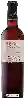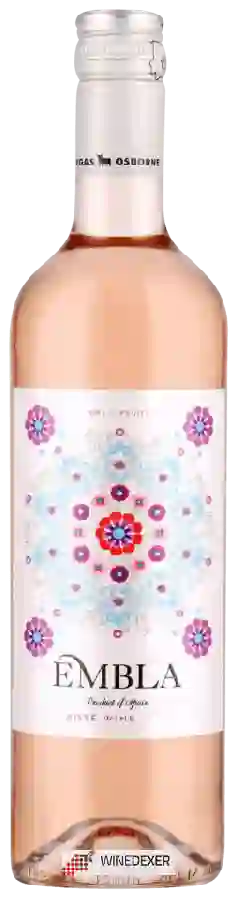
Winery OsborneEmbla Rosé
 Pink wine



This wine generally goes well with beef, lamb or mature and hard cheese.
Food and wine pairings with Embla Rosé
Pairings that work perfectly with Embla Rosé



Original food and wine pairings with Embla Rosé

The Embla Rosé of Winery Osborne matches generally quite well with dishes of beef, lamb or spicy food such as recipes of roast beef in a crust (onions & mustard), shoulder of lamb in a crust or mahi mahi curry with coconut milk.
Details and technical informations about Winery Osborne's Embla Rosé.
Discover the grape variety: Bronner
An interspecific cross between merzling and rondo obtained in 1975 by Norbert Becker of the Freiburg Research Institute in Germany. It has the particularity of having only one gene for resistance to mildew and powdery mildew. However, the I.N.R.A. Bordeaux Sciences Agro has since noted a loss of efficiency on mildew due to a bypass. It can be found in Denmark, the Netherlands, Germany, Belgium, Italy, England, etc. It is not very widespread today and is almost unknown in France. It should not be confused with another variety of the same name, which comes from a Pinot Blanc seedling, also obtained in Germany by Johann Philipp Bronner.
Last vintages of this wine
The best vintages of Embla Rosé from Winery Osborne are 2017, 0, 2018
Informations about the Winery Osborne
The Winery Osborne is one of of the world's great estates. It offers 89 wines for sale in the of Castille-et-Léon to come and discover on site or to buy online.

The wine region of Castille-et-Léon
Located in the northern half of the Central Iberian plateau, Castilla y León is the largest of Spain's 17 administrative regions, covering about one-fifth of the country's total area. It extends about 350 kilometres (220 miles) from central Spain to the northern coast. Just as wide, it connects the Rioja wine region to the Portuguese border. Red wines reign supreme in Castilla y León, and the Tempranillo grape is undoubtedly the king.
The word of the wine: VDQS
Delimited wine of superior quality. A level of appellation (today, barely 1% of French production) which constitutes the ultimate step before the accession to the AOC.