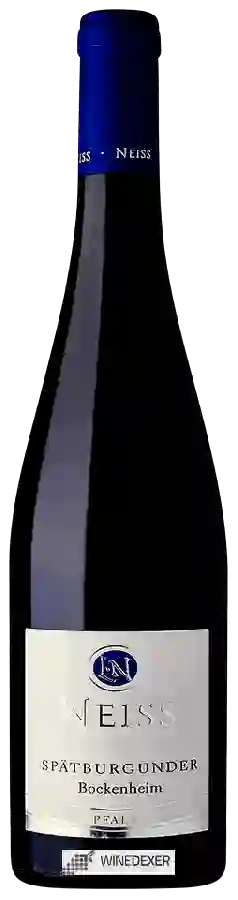
Winery NeissSpätburgunder Bockenheim
 Red wine


In the mouth this red wine is a with a nice freshness.
This wine generally goes well with poultry, beef or veal.

Taste structure of the Spätburgunder Bockenheim from the Winery Neiss
Light | Bold | |
Smooth | Tannic | |
Dry | Sweet | |
Soft | Acidic |
In the mouth the Spätburgunder Bockenheim of Winery Neiss in the region of Pfalz is a with a nice freshness.
Wine flavors and olphactive analysis





On the nose the Spätburgunder Bockenheim of Winery Neiss in the region of Pfalz often reveals types of flavors of non oak, earth or oak and sometimes also flavors of spices, red fruit or black fruit.
Food and wine pairings with Spätburgunder Bockenheim
Pairings that work perfectly with Spätburgunder Bockenheim



Original food and wine pairings with Spätburgunder Bockenheim

The Spätburgunder Bockenheim of Winery Neiss matches generally quite well with dishes of beef, veal or game (deer, venison) such as recipes of beef tongue with mushrooms, veal escalope with lemon sauce or rabbit with cream sauce anne's way.
Details and technical informations about Winery Neiss's Spätburgunder Bockenheim.
Discover the grape variety: Tinta da Madeira
Light, fruity reds with a pale colour, light ruby colour, soft tannins and a light palate with preserved acidity, featuring aromas of red fruits (cherry, raspberry) and gentle island spices. Discreet Madeiran profile. Very rare, preserved for its heritage value; it contributes to artisanal island blends and belongs to the indigenous varieties of Madeira under study. Indigenous Portuguese black variety from the island of Madeira.
Last vintages of this wine

The best vintages of Spätburgunder Bockenheim from Winery Neiss are 2016, 2015, 0, 2014
Informations about the Winery Neiss
The Winery Neiss is one of of the world's greatest estates. It offers 60 wines for sale in the of Pfalz to come and discover on site or to buy online.

The wine region of Pfalz
Fleshy, dry, fruity Riesling is the region's signature: yellow peach, apricot, ripe citrus, lovely mineral tension. Germany's largest red-wine area (40%), with silky Spätburgunder showing red fruit and spice, darker structured Dornfelder, supple Portugieser. Some rounded Pinot Blanc and Pinot Gris. A 23,640 ha vineyard along the Haardt, among Germany's warmest (>2,000 h of sun).
The word of the wine: Vitis vinifera
The main species of vine cultivated in Europe and throughout the world, the origin of most of the great grape varieties.