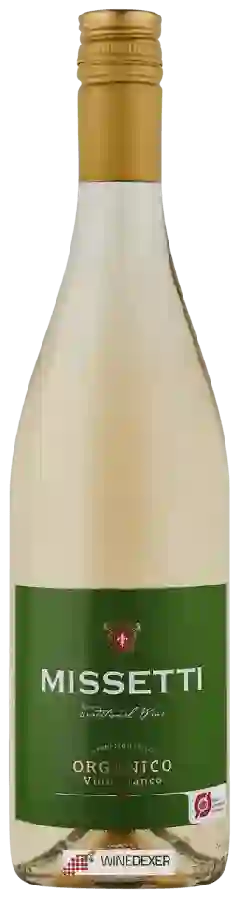
Winery MissettiOrganico Bianco
 White wine



In the mouth this white wine is a powerful.
This wine generally goes well with lean fish, shellfish or mature and hard cheese.
Taste structure of the Organico Bianco from the Winery Missetti
Light | Bold | |
Dry | Sweet | |
Soft | Acidic |
In the mouth the Organico Bianco of Winery Missetti in the region of Veneto is a powerful.
Food and wine pairings with Organico Bianco
Pairings that work perfectly with Organico Bianco



Original food and wine pairings with Organico Bianco


The Organico Bianco of Winery Missetti matches generally quite well with dishes of pasta, shellfish or mature and hard cheese such as recipes of multicoloured butterfly pasta, brasucade of mussels from languedoc or gratin in pink and blue.
Details and technical informations about Winery Missetti's Organico Bianco.
Discover the grape variety: Côt
Ribs have travelled a long way! In the Middle Ages it was indeed cultivated in the Yonne region. In Bordeaux, it was used in the production of vins clairets and was present in the Loire Valley where today it is only used in the AOC Touraine and Rosé d'Anjou. It goes by different names: Malbec in Bordeaux or Auxerrois in Cahors, in the Quercy vineyards, where it flourishes.it is a very old red grape variety with medium-sized bunches and berries with melting, juicy and sweet flesh. Very sensitive to frost, disease and temperature changes, it is very productive if preserved and if it reaches a good maturity.côt is used in the vineyards of several major appellations such as the AOC Médoc, Graves, Saint-Emilion, Pomerol, Bergerac, Pécharmant, Buzet, Malepère, Marcillac... Wines made from this grape variety are fruity, tannic, deep in colour and have good ageing potential Cultivated on a surface of 5.000 hectares in France, the côt is also very present in Argentina and Chile.
Last vintages of this wine
The best vintages of Organico Bianco from Winery Missetti are 2017, 0
Informations about the Winery Missetti
The Winery Missetti is one of of the world's greatest estates. It offers 5 wines for sale in the of Veneto to come and discover on site or to buy online.

The wine region of Veneto
Veneto is an important and growing wine region in northeastern Italy. Veneto is administratively Part of the Triveneto area, aLong with its smaller neighbors, Trentino-Alto Adige and Friuli-Venezia Giulia. In terms of geography, culture and wine styles, it represents a transition from the Alpine and Germanic-Slavic end of Italy to the warmer, drier, more Roman lands to the South. Veneto is slightly smaller than the other major Italian wine regions - Piedmont, Tuscany, Lombardy, Puglia and Sicily - but it produces more wine than any of them.
The word of the wine: Piccolo
Small bottle with a capacity of 20 centilitres.