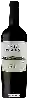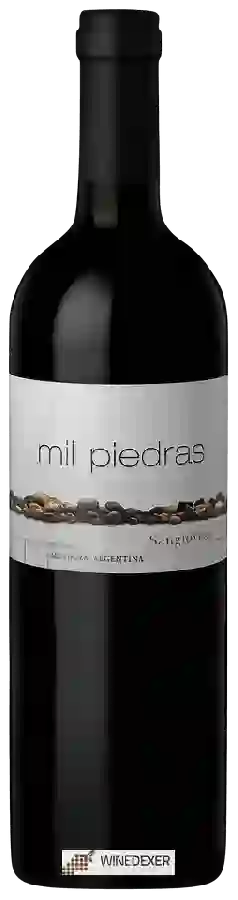
Winery Mil PiedrasSangiovese
 Red wine


In the mouth this red wine is a powerful with a nice balance between acidity and tannins.
This wine generally goes well with poultry, beef or veal.
Taste structure of the Sangiovese from the Winery Mil Piedras
Light | Bold | |
Smooth | Tannic | |
Dry | Sweet | |
Soft | Acidic |
In the mouth the Sangiovese of Winery Mil Piedras in the region of Mendoza is a powerful with a nice balance between acidity and tannins.
Wine flavors and olphactive analysis


On the nose the Sangiovese of Winery Mil Piedras in the region of Mendoza often reveals types of flavors of oak.
Food and wine pairings with Sangiovese
Pairings that work perfectly with Sangiovese



Original food and wine pairings with Sangiovese

The Sangiovese of Winery Mil Piedras matches generally quite well with dishes of beef, veal or game (deer, venison) such as recipes of venison stew to be prepared the day before, marinated veal skewers with herbs or casserons in the country style.
Details and technical informations about Winery Mil Piedras's Sangiovese.
Discover the grape variety: Sangiovese
Originally from Italy, it is the famous Sangiovese of Tuscany producing the famous wines of Brunello de Montalcino and Chianti. This variety is registered in the Official Catalogue of Wine Grape Varieties, list A1. According to recent genetic analysis, it is the result of a natural cross between the almost unknown Calabrese di Montenuovo (mother) and Ciliegiolo (father).
Last vintages of this wine

The best vintages of Sangiovese from Winery Mil Piedras are 2015, 2014, 0, 2012 and 2009.
Informations about the Winery Mil Piedras
The Winery Mil Piedras is one of of the world's greatest estates. It offers 6 wines for sale in the of Mendoza to come and discover on site or to buy online.

The wine region of Mendoza
Mendoza is by far the largest wine region in Argentina. Located on a high-altitude plateau at the edge of the Andes Mountains, the province is responsible for roughly 70 percent of the country's annual wine production. The French Grape variety Malbec has its New World home in the vineyards of Mendoza, producing red wines of great concentration and intensity. The province Lies on the western edge of Argentina, across the Andes Mountains from Chile.
The word of the wine: Aggressive
Said of a wine with excessive, biting and unpleasant acidity.