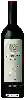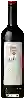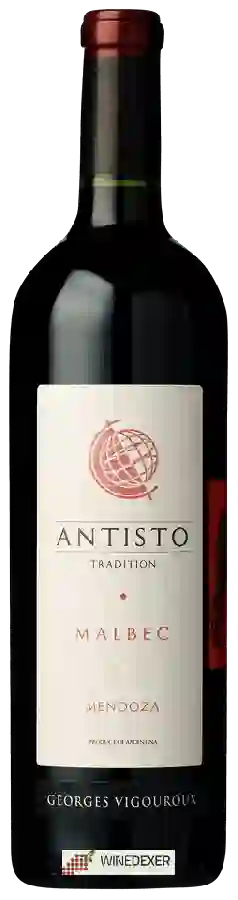
Winery Georges VigourouxAntisto Mendoza
 Red wine



In the mouth this red wine is a powerful.
This wine generally goes well with poultry, beef or lamb.
Taste structure of the Antisto Mendoza from the Winery Georges Vigouroux
Light | Bold | |
Smooth | Tannic | |
Dry | Sweet | |
Soft | Acidic |
In the mouth the Antisto Mendoza of Winery Georges Vigouroux in the region of Mendoza is a powerful.


Food and wine pairings with Antisto Mendoza
Pairings that work perfectly with Antisto Mendoza



Original food and wine pairings with Antisto Mendoza
The Antisto Mendoza of Winery Georges Vigouroux matches generally quite well with dishes of beef, lamb or poultry such as recipes of millet with gruyere cheese, mouse of lamb with thyme or clopinettes in field dresses.
Details and technical informations about Winery Georges Vigouroux's Antisto Mendoza.
Discover the grape variety: Malbec
Malbec, a high-yielding red grape variety, produces tannic and colourful wines. It is produced in different wine-growing regions and changes its name according to the grape variety. Called Auxerrois in Cahors, Malbec in Bordeaux, it is also known as Côt. 6,000 hectares of the Malbec grape are grown in France (in decline since the 1950s). Malbec is also very successful in Argentina. The country has become the world's leading producer of Malbec and offers wines with great potential.
Last vintages of this wine
The best vintages of Antisto Mendoza from Winery Georges Vigouroux are 2012, 2017, 2014
Informations about the Winery Georges Vigouroux
The Winery Georges Vigouroux is one of of the world's great estates. It offers 108 wines for sale in the of Mendoza to come and discover on site or to buy online.

The wine region of Mendoza
Mendoza is by far the largest wine region in Argentina. Located on a high-altitude plateau at the edge of the Andes Mountains, the province is responsible for roughly 70 percent of the country's annual wine production. The French Grape variety Malbec has its New World home in the vineyards of Mendoza, producing red wines of great concentration and intensity. The province Lies on the western edge of Argentina, across the Andes Mountains from Chile.
The word of the wine: Vinosity
When tasting a red wine, a pleasant sensation on the palate with a fruity and sappy character in harmony with a caressing and persistent presence of tannins.