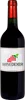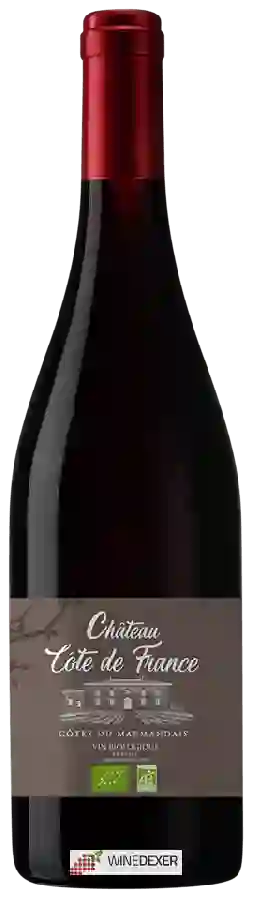
Cave du MarmandaisChateau Côtes de France
 Red wine



This wine generally goes well with
Wine flavors and olphactive analysis

On the nose the Chateau Côtes de France of Cave du Marmandais in the region of South West often reveals types of flavors of spices.
Details and technical informations about Cave du Marmandais's Chateau Côtes de France.
Discover the grape variety: Gaillard 157
Interspecific crossing carried out in 1891 by Fernand Gaillard (1821-1905) between (triumph x eumelan) and 1 Seibel. This direct-producing hybrid was multiplied in particular in the south-west and centre-west of France as well as in the departments of the Rhône valley and the Ain.
Last vintages of this wine
The best vintages of Chateau Côtes de France from Cave du Marmandais are 2009, 2011, 2016, 2014 and 2010.
Informations about the Cave du Marmandais
The Cave du Marmandais is one of of the world's great estates. It offers 172 wines for sale in the of Côtes du Marmandais to come and discover on site or to buy online.

The wine region of Côtes du Marmandais
Côtes du Marmandais is a satellite district of the Bordeaux wine region in Southwest France. It owes its name to the town of Marmande at its centre, which Lies on the North bank of the Garonne. The appellation AOC Côtes du Marmandais covers red, white and rosé wines produced from grapes grown in defined areas of the parishes around Marmande. The Garonne River divides the Marmande district into two Parts, the north and the south, which are eastern extensions of the Entre-deux-Mers and Graves regions respectively.
The wine region of South West
The South-West is a large territorial area of France, comprising the administrative regions of Aquitaine, Limousin and Midi-Pyrénées. However, as far as the French wine area is concerned, the South-West region is a little less clear-cut, as it excludes Bordeaux - a wine region so productive that it is de facto an area in its own right. The wines of the South West have a Long and eventful history. The local rivers play a key role, as they were the main trade routes to bring wines from traditional regions such as Cahors, Bergerac, Buzet and Gaillac to their markets.
The word of the wine: VDN
Natural sweet wine. Wine obtained by mutage of the must during fermentation by adding over-finished alcohol at 96 °, produced in the vineyards of Roussillon, Languedoc, Rhone Valley and Corsica.