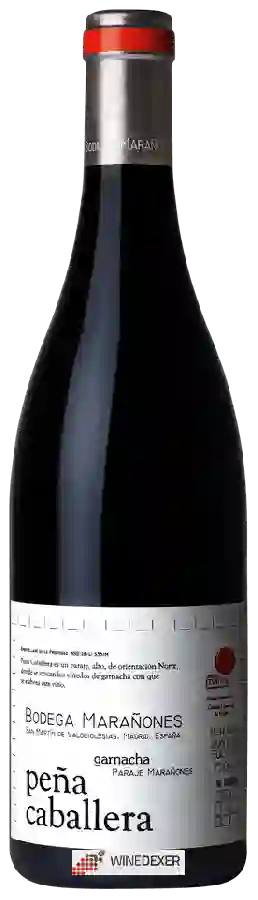
Bodega MarañonesPeña Caballera Garnacha
 Red wine



In the mouth this red wine is a powerful with a nice balance between acidity and tannins.
This wine generally goes well with poultry, beef or game (deer, venison).
The Peña Caballera Garnacha of the Bodega Marañones is in the top 40 of wines of Madrid.
Taste structure of the Peña Caballera Garnacha from the Bodega Marañones
Light | Bold | |
Smooth | Tannic | |
Dry | Sweet | |
Soft | Acidic |
In the mouth the Peña Caballera Garnacha of Bodega Marañones in the region of Madrid is a powerful with a nice balance between acidity and tannins.
Wine flavors and olphactive analysis





On the nose the Peña Caballera Garnacha of Bodega Marañones in the region of Madrid often reveals types of flavors of cherry, oaky or minerality and sometimes also flavors of red fruit, strawberries or plum.
Food and wine pairings with Peña Caballera Garnacha
Pairings that work perfectly with Peña Caballera Garnacha



Original food and wine pairings with Peña Caballera Garnacha


The Peña Caballera Garnacha of Bodega Marañones matches generally quite well with dishes of beef, pasta or lamb such as recipes of fillet of beef in a foie gras and truffle crust, pasta with ham or couscous of meat and fish.
Details and technical informations about Bodega Marañones's Peña Caballera Garnacha.
Discover the grape variety: Cabernet-Volos
An interspecific cross between Cabernet Sauvignon and Bianca obtained in Italy in 2002 by the University of Udine and the Institute of Applied Genetics. It can be found in Germany, Slovakia, ... in France it is almost unknown.
Last vintages of this wine
The best vintages of Peña Caballera Garnacha from Bodega Marañones are 2017, 2015, 2013, 2011 and 2012.
Informations about the Bodega Marañones
The Bodega Marañones is one of of the world's greatest estates. It offers 13 wines for sale in the of Madrid to come and discover on site or to buy online.

The wine region of Madrid
Vinos de Madrid is the DO (Denominación de Origen) title that covers the vineyards around Madrid, the capital of Spain. Located in the heart of the country, Madrid is the second largest city in the European Union. It offers its millions of visitors elaborate architecture, art galleries, a vibrant nightlife and a multitude of fine restaurants that often feature local wines. The sprawling metropolis and the towering Sierra de Guadarrama mountains to the North confine the vineyards to the southeast and southwest corners of the autonomous community of Madrid.
The word of the wine: Apyrene
Seedless grape.