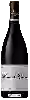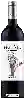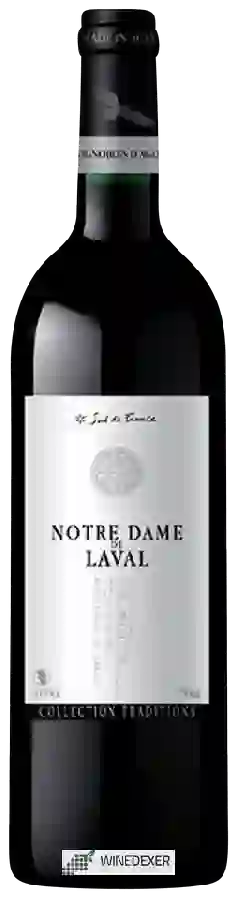
Les Vignobles des Côtes d'AglyNotre Dame de Laval Côtes du Roussillon
 Red wine


In the mouth this red wine is a powerful with a nice balance between acidity and tannins.
This wine generally goes well with beef, veal or pasta.
Taste structure of the Notre Dame de Laval Côtes du Roussillon from the Les Vignobles des Côtes d'Agly
Light | Bold | |
Smooth | Tannic | |
Dry | Sweet | |
Soft | Acidic |
In the mouth the Notre Dame de Laval Côtes du Roussillon of Les Vignobles des Côtes d'Agly in the region of Languedoc-Roussillon is a powerful with a nice balance between acidity and tannins.
Wine flavors and olphactive analysis



On the nose the Notre Dame de Laval Côtes du Roussillon of Les Vignobles des Côtes d'Agly in the region of Languedoc-Roussillon often reveals types of flavors of oak, spices or red fruit and sometimes also flavors of black fruit.
Food and wine pairings with Notre Dame de Laval Côtes du Roussillon
Pairings that work perfectly with Notre Dame de Laval Côtes du Roussillon



Original food and wine pairings with Notre Dame de Laval Côtes du Roussillon
The Notre Dame de Laval Côtes du Roussillon of Les Vignobles des Côtes d'Agly matches generally quite well with dishes of beef, pasta or veal such as recipes of family potluck, zucchini and goat cheese lasagna or milanese cutlets like in italy.
Details and technical informations about Les Vignobles des Côtes d'Agly's Notre Dame de Laval Côtes du Roussillon.
Discover the grape variety: Gamay noir
Gamay is a Burgundian grape variety that has existed since the 14th century. For fear of competition with the pinot noir of Burgundy, gamay was finally uprooted and planted in the Beaujolais region, from Mâcon to Lyon. These siliceous and granitic soils suit it perfectly, and it gives its best here. But it is also planted all over France, such as in Lorraine, in the Loire Valley, in Bugey, in Savoie and in Auvergne. Gamay is early and very productive and needs to be limited so that quality prevails over quantity. Short winter pruning of the shoots and high density of vines per hectare are the methods that allow it to produce very fruity, fresh and greedy red wines. Gamay is also very popular in red wine futures, and produces wines from the Beaujolais region with very interesting character and ageing potential. The AOCs Crémant-de-Bourgogne, Mâcon, Anjou, Touraine, Rosé de vallée de la Loire, Côtes-d'Auvergne, Saint-Pourçain, Bugey, Gaillac, Côtes du Luberon... and many vins de pays are proud of it. Today, about 36,000 hectares of Gamay are cultivated in France, including 22,000 hectares in Beaujolais.
Last vintages of this wine

The best vintages of Notre Dame de Laval Côtes du Roussillon from Les Vignobles des Côtes d'Agly are 2014, 2010, 2011, 2015 and 2012.
Informations about the Les Vignobles des Côtes d'Agly
The Les Vignobles des Côtes d'Agly is one of of the world's great estates. It offers 74 wines for sale in the of Côtes du Roussillon to come and discover on site or to buy online.

The wine region of Côtes du Roussillon
Côtes du Roussillon is an appellation contrôlée for red, white and rosé wines from the Roussillon wine region in southern France. It covers the eastern half of the administrative district of the Pyrénées-Orientales, on the eastern edge of the Pyrenees. The western half of the Pyrenees-Orientales is simply too mountainous for effective viticulture. In the Côtes du Roussillon wine-growing area is the Aspres sub-region.
The wine region of Languedoc-Roussillon
Languedoc (formerly Coteaux du Languedoc) is a key appellation used in the Languedoc-Roussillon wine region of southern France. It covers Dry table wines of all three colors (red, white and rosé) from the entire region, but leaves Sweet and Sparkling wines to other more specialized appellations. About 75% of all Languedoc wines are red, with the remaining 25% split roughly down the middle between whites and rosés. The appellation covers most of the Languedoc region and almost a third of all the vineyards in France.
The word of the wine: Tressallier
White grape variety from the Allier region, identical to the Sacy variety grown in Burgundy. Rarely vinified on its own, it is used in the blending of Saint-Pourçain white wines, associated with chardonnay, the main grape variety of the appellation. Syn.: sacy.