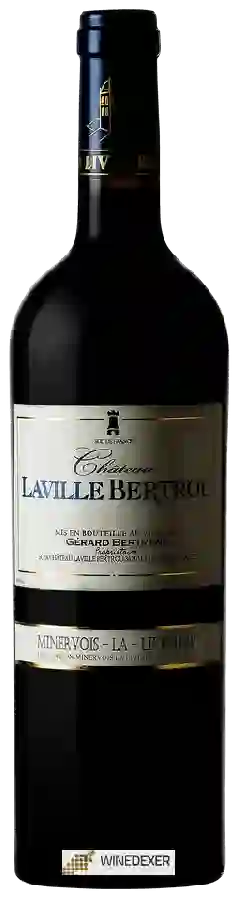
Château Laville BertrouMinervois La Livinière
 Red wine


This wine is a blend of 3 varietals which are the Carignan, the Syrah and the Grenache noir.
In the mouth this red wine is a powerful with a nice balance between acidity and tannins.
This wine generally goes well with beef, veal or pasta.

Taste structure of the Minervois La Livinière from the Château Laville Bertrou
Light | Bold | |
Smooth | Tannic | |
Dry | Sweet | |
Soft | Acidic |
In the mouth the Minervois La Livinière of Château Laville Bertrou in the region of Languedoc-Roussillon is a powerful with a nice balance between acidity and tannins.
Wine flavors and olphactive analysis






On the nose the Minervois La Livinière of Château Laville Bertrou in the region of Languedoc-Roussillon often reveals types of flavors of cherry, oaky or smoke and sometimes also flavors of earthy, blackberry or blueberry.
Food and wine pairings with Minervois La Livinière
Pairings that work perfectly with Minervois La Livinière



Original food and wine pairings with Minervois La Livinière
The Minervois La Livinière of Château Laville Bertrou matches generally quite well with dishes of beef, veal or pasta such as recipes of beef tongue with pickle sauce, simple and fragrant roast veal or pasta stuffed with meat.
Details and technical informations about Château Laville Bertrou's Minervois La Livinière.
Discover the grape variety: Carignan
Intensely coloured and powerful reds with a deep colour, firm tannins and high acidity, on aromas of blackberry, blackcurrant, plum, garrigue, pepper, liquorice and balsamic notes. Old vines (>50 years, often centenary) yield exceptional cuvées. A historical pillar of Languedoc-Roussillon blends (Corbières, Minervois, Fitou, Maury) and star of Catalan Priorat under the name Cariñena. Very late-ripening variety from Aragon, also called Mazuelo in Rioja.
Last vintages of this wine
The best vintages of Minervois La Livinière from Château Laville Bertrou are 2020, 2017, 2022, 2019 and 2018.
Informations about the Château Laville Bertrou
The Château Laville Bertrou is one of of the world's greatest estates. It offers 8 wines for sale in the of Minervois La Livinière to come and discover on site or to buy online.

The wine region of Minervois La Livinière
Languedoc cru (>400 m, tertiary limestone terroir dominating Cesse gorges): Grenache, Syrah and Mourvèdre blend (>=60%, incl. 40% Syrah-Mourvèdre) as flagship red, with Carignan, Cinsault and autochthons — intense aromas of black fruits, spices and garrigue, liquorice and cocoa notes from ageing, fine concentration, silky tannins and long finish. Cool Languedoc climate, schists, sandstone, quartz and limestone.
The wine region of Languedoc-Roussillon
Largest single French vineyard, dominated by sunny, generous reds. Spicy Syrah, candied Grenache (ripe fruit, garrigue), structured Carignan, deep Mourvèdre, supple Cinsault. Stars: structured Corbières, Minervois, Faugères, Saint-Chinian; round Côtes-du-Roussillon. Legendary vins doux naturels: Banyuls and Maury (fortified Grenache) with notes of cocoa, fig, prune.
The word of the wine: Nouaison
Phase of the vegetative cycle of the vine following flowering and corresponding to the formation of the grape berry.





