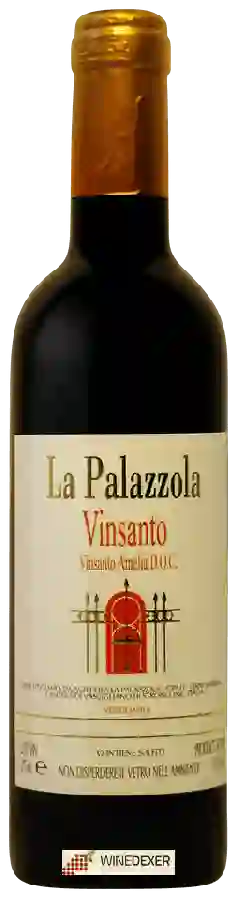
Winery La PalazzolaVinsanto Amelia
 Sweet wine


This wine generally goes well with pork, beef or lamb.
Food and wine pairings with Vinsanto Amelia
Pairings that work perfectly with Vinsanto Amelia



Original food and wine pairings with Vinsanto Amelia

The Vinsanto Amelia of Winery La Palazzola matches generally quite well with dishes of beef, lamb or pork such as recipes of harira de mamie (moroccan soup), lamb chops with spanish sauce or soft and inexpensive pasta gratin.
Details and technical informations about Winery La Palazzola's Vinsanto Amelia.
Discover the grape variety: Frankenthal
It is said to be of Austrian origin, from the Tyrol to be precise, and for some it comes from Franconia in Germany. Some ampelographers consider that Frankenthal and Kavcina crna or Zametovka grown in Slovenia are identical, with perhaps only a few clonal differences, which have yet to be confirmed, although it is true that they all have a large number of synonyms in common. Frankenthal can still be found in Belgium, the Netherlands, Germany, Austria, Hungary, Slovenia, Croatia, Italy, Portugal, England, Chile and Australia. For a long time, it was cultivated under greenhouses as a table grape in the North, East and West of France. Today, it has been almost abandoned and is therefore in danger of disappearing.
Last vintages of this wine

The best vintages of Vinsanto Amelia from Winery La Palazzola are 0, 2011
Informations about the Winery La Palazzola
The Winery La Palazzola is one of of the world's greatest estates. It offers 27 wines for sale in the of Amelia to come and discover on site or to buy online.

The wine region of Amelia
The wine region of Amelia is located in the region of Ombrie of Italy. Wineries and vineyards like the Domaine Zanchi or the Domaine Zanchi produce mainly wines red, white and sweet. The most planted grape varieties in the region of Amelia are Sangiovese, Ciliegiolo and Merlot, they are then used in wines in blends or as a single variety. On the nose of Amelia often reveals types of flavors of earth, oak or red fruit and sometimes also flavors of non oak, black fruit.
The wine region of Umbria
Umbria, in CentralItaly, is a region of lush hills, hilltop villages and iconic historic towns. The latter are exemplified by Orvieto and Assisi. At the very heart of the Italian peninsula, it is surrounded by Tuscany, Marche and Lazio. It is in fact the only Italian region without a coastline or international border.
The word of the wine: Varietal
Said of wine aromas that are reminiscent of fresh grapes. The most demonstrative example is certainly that of wines made from the Muscat grape variety.