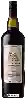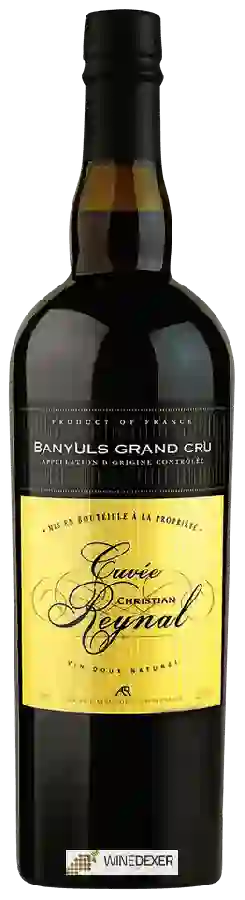
Winery Abbe RousCuvée Christian Reynal Banyuls Grand Cru
 Natural sweet wine


This wine generally goes well with beef and mature and hard cheese.


Food and wine pairings with Cuvée Christian Reynal Banyuls Grand Cru
Pairings that work perfectly with Cuvée Christian Reynal Banyuls Grand Cru


Original food and wine pairings with Cuvée Christian Reynal Banyuls Grand Cru
The Cuvée Christian Reynal Banyuls Grand Cru of Winery Abbe Rous matches generally quite well with dishes of beef or mature and hard cheese such as recipes of baked lasagna or pasta gratin with comté cheese.
Details and technical informations about Winery Abbe Rous's Cuvée Christian Reynal Banyuls Grand Cru.
Discover the grape variety: Ekigaïna
Ekigaïna noir is a grape variety that originated in France (Languedoc). It produces a variety of grape specially used for wine making. It is rare to find this grape to eat on our tables. This variety of grape is characterized by medium-sized bunches and small grapes. Ekigaïna noir can be found in several vineyards: South-West, Cognac, Bordeaux, Provence & Corsica, Languedoc & Roussillon, Rhone Valley, Armagnac.
Last vintages of this wine
The best vintages of Cuvée Christian Reynal Banyuls Grand Cru from Winery Abbe Rous are 2000, 1998
Informations about the Winery Abbe Rous
The Winery Abbe Rous is one of of the world's great estates. It offers 50 wines for sale in the of Banyuls Grand Cru to come and discover on site or to buy online.

The wine region of Banyuls Grand Cru
The wine region of Banyuls Grand Cru is located in the region of Banyuls of Languedoc-Roussillon of France. Wineries and vineyards like the Domaine Terres des Templiers or the Domaine Terres des Templiers produce mainly wines natural sweet and red. On the nose of Banyuls Grand Cru often reveals types of flavors of oak, coffee or raisin and sometimes also flavors of apricot, red fruit or vegetal. We currently count 10 estates and châteaux in the of Banyuls Grand Cru, producing 31 different wines in conventional, organic and biodynamic agriculture.
The wine region of Languedoc-Roussillon
Languedoc (formerly Coteaux du Languedoc) is a key appellation used in the Languedoc-Roussillon wine region of southern France. It covers Dry table wines of all three colors (red, white and rosé) from the entire region, but leaves Sweet and Sparkling wines to other more specialized appellations. About 75% of all Languedoc wines are red, with the remaining 25% split roughly down the middle between whites and rosés. The appellation covers most of the Languedoc region and almost a third of all the vineyards in France.
The word of the wine: Tranquil (wine)
Refers to a non-sparkling wine.