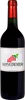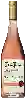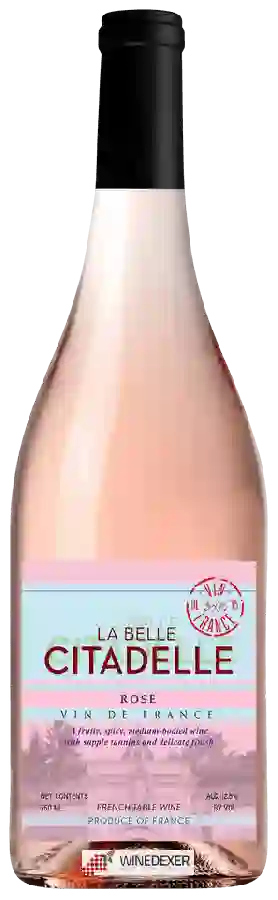
Winery La Belle CitadelleRosé
 Pink wine


This wine generally goes well with beef, lamb or mature and hard cheese.
Food and wine pairings with Rosé
Pairings that work perfectly with Rosé



Original food and wine pairings with Rosé


The Rosé of Winery La Belle Citadelle matches generally quite well with dishes of beef, lamb or spicy food such as recipes of sauté of lamb with curry, mediterranean lamb necklace or pasta with puttanesca sauce.
Details and technical informations about Winery La Belle Citadelle's Rosé.
Discover the grape variety: Malvoisie de Lipari
A very old vine, said to have originated in Greece. It is found in Spain, including the Canary Islands, in Portugal, including Madeira, in Croatia, etc., and is virtually unknown in France. It should be noted that many varieties have the synonym "malvasia" and therefore confusion between them is always possible, such as vermentino or tourbat with the Malvasia of Lipari, whose grapes are however quite different. - Synonyms: malvasia fina, malvasia de Sitges, malvasia grossa, malvasio dubrovcka, greco di Gerace (for all the synonyms of the grape varieties, click here!)
Last vintages of this wine
The best vintages of Rosé from Winery La Belle Citadelle are 0
Informations about the Winery La Belle Citadelle
The Winery La Belle Citadelle is one of of the world's greatest estates. It offers 6 wines for sale in the of Vin de France to come and discover on site or to buy online.

The wine region of Vin de France
Vin de France is the most basic level of quality for wines from France. These are generally uncomplicated everyday drinks - most often blends, but perhaps also Varietal wines based on a well-known Grape variety such as Cabernet Sauvignon, Merlot, Chardonnay or Sauvignon Blanc. Wines from France are those that do not meet the criteria stipulated by the Protected Designation of Origin (PDO) or Protected Geographical Indication (PGI) laws (see information on French wine labels). This may be because the vineyards are outside the delimited production areas or because the grape varieties or winemaking techniques used do not conform to the rules of the local appellations.
The word of the wine: Residual sugars
Sugars not transformed into alcohol and naturally present in the wine. The perception of residual sugars is conditioned by the acidity of the wine. The more acidic the wine is, the less sweet it will seem, given the same amount of sugar.