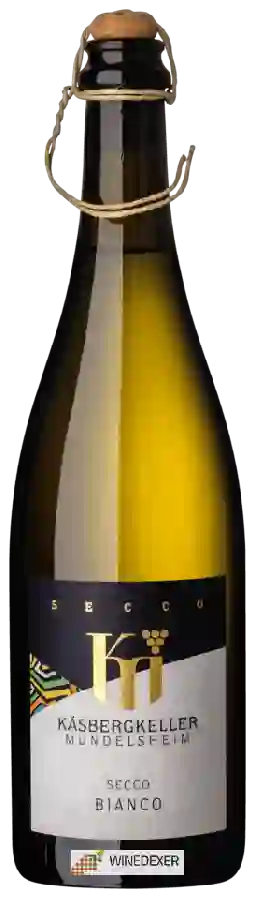
Winery Käsbergkeller MundelsheimSecco Bianco
 Sparkling wine
This wine is a blend of 2 varietals which are the Kerner and the Riesling.
This wine generally goes well with pork, vegetarian or poultry.
Food and wine pairings with Secco Bianco
Pairings that work perfectly with Secco Bianco



Original food and wine pairings with Secco Bianco



The Secco Bianco of Winery Käsbergkeller Mundelsheim matches generally quite well with dishes of pork, rich fish (salmon, tuna etc) or shellfish such as recipes of pork roulades with cream and mushrooms, salmon in brick pastry or sublime fish and shrimp colombo.
Details and technical informations about Winery Käsbergkeller Mundelsheim's Secco Bianco.
Discover the grape variety: Kerner
Intraspecific crossing between frankenthal and riesling obtained in Germany in 1929 by August Karl Herold (1902/1973). In 1951 and by crossing it with the sylvaner, we obtained the juwel. It should be noted that there is a mutation of Kerner, discovered in 1974 and bearing the name of kernling, with grapes of pink-grey to red-grey colour at full maturity. Kerner can be found in Germany, Belgium, Slovenia, Austria, Switzerland, Italy, South Africa, Australia, the United States, Canada, Japan... practically unknown in France except in a few Moselle vineyards.
Informations about the Winery Käsbergkeller Mundelsheim
The Winery Käsbergkeller Mundelsheim is one of of the world's greatest estates. It offers 59 wines for sale in the of Württemberg to come and discover on site or to buy online.

The wine region of Württemberg
Württemberg is known as Germany's premier red wine region. With almost 11,500 hectares (28,500 acres) of vineyards, it is the fourth-largest wine region in the country. Found adjacent to Baden and South of Franken, Wüttemberg is a particularly hilly and rural wine-region. Almost 70-percent of Württemberg wines are red, predominantly made from Trollinger, SchwarzRiesling and Lemberger.
The word of the wine: Food and wine pairing
It is the set of techniques that allow for the pleasant combination of food and wine. Food and wine pairing is based on a few basic principles, such as similarity, complementarity or contrast, and involves all the elements that make up the wine and the food (flavours, textures, aromas, etc.).