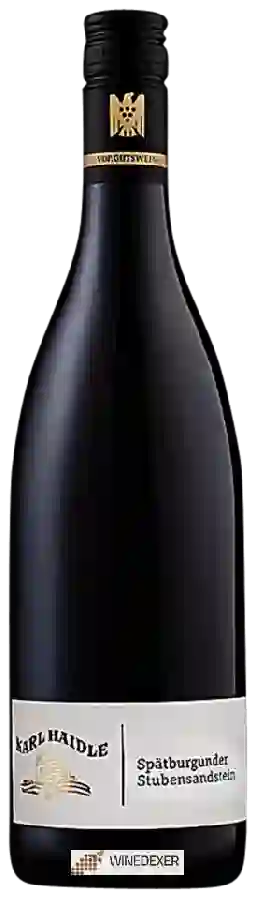
Winery Karl HaidleSpätburgunder Stubensandstein
 Red wine


In the mouth this red wine is a with a nice freshness.
This wine generally goes well with poultry, beef or veal.

Taste structure of the Spätburgunder Stubensandstein from the Winery Karl Haidle
Light | Bold | |
Smooth | Tannic | |
Dry | Sweet | |
Soft | Acidic |
In the mouth the Spätburgunder Stubensandstein of Winery Karl Haidle in the region of Württemberg is a with a nice freshness.
Food and wine pairings with Spätburgunder Stubensandstein
Pairings that work perfectly with Spätburgunder Stubensandstein



Original food and wine pairings with Spätburgunder Stubensandstein

The Spätburgunder Stubensandstein of Winery Karl Haidle matches generally quite well with dishes of beef, veal or game (deer, venison) such as recipes of beef stew with white wine, roast veal in the oven or rack of lamb with herbs.
Details and technical informations about Winery Karl Haidle's Spätburgunder Stubensandstein.
Discover the grape variety: Cornalin d'Aoste
Deep, structured reds with a dark, intense ruby color, firm tannins and a dense palate, offering intense aromas of black fruits (blackberry, blackcurrant), black cherry, spices, pepper, alpine and balsamic notes. Fine cellaring potential; mountain wines from altitude. Star of Valle d'Aosta DOC, grown on sun-drenched terraces between Aymavilles and Chambave. Italian indigenous variety of the Aosta Valley, distinct from Valais cornalin (rouge du pays).
Last vintages of this wine

The best vintages of Spätburgunder Stubensandstein from Winery Karl Haidle are 2018, 0, 2016, 2017
Informations about the Winery Karl Haidle
The Winery Karl Haidle is one of of the world's great estates. It offers 72 wines for sale in the of Württemberg to come and discover on site or to buy online.

The wine region of Württemberg
Rare predominantly red region in Germany (nearly 70%). Supple, fruity everyday reds: light, crisp Trollinger (Schiava) with red fruits, more structured, spicy, deep Lemberger (Blaufränkisch), generous Schwarzriesling (Pinot Meunier). Riesling king of whites (>2,000 ha), lively and mineral, citrus and green apple. Germany's 4th region (11,500 ha) on the Neckar slopes around Heilbronn and Stuttgart.
The word of the wine: Feedback
Perception of the aromas in the mouth by the retro-nasal way.