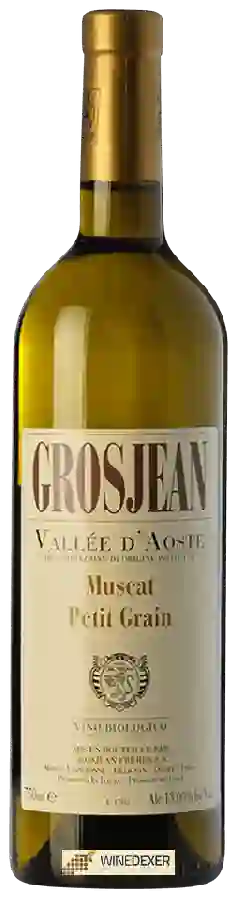
Winery GrosjeanMuscat Petit Grain
 White wine



In the mouth this white wine is a powerful with a nice freshness.
This wine generally goes well with lean fish, shellfish or mature and hard cheese.
Taste structure of the Muscat Petit Grain from the Winery Grosjean
Light | Bold | |
Dry | Sweet | |
Soft | Acidic |
In the mouth the Muscat Petit Grain of Winery Grosjean in the region of Valle d'Aosta is a powerful with a nice freshness.
Wine flavors and olphactive analysis

On the nose the Muscat Petit Grain of Winery Grosjean in the region of Valle d'Aosta often reveals types of flavors of earth.
Food and wine pairings with Muscat Petit Grain
Pairings that work perfectly with Muscat Petit Grain



Original food and wine pairings with Muscat Petit Grain


The Muscat Petit Grain of Winery Grosjean matches generally quite well with dishes of pasta, shellfish or mature and hard cheese such as recipes of tagliatelle with spinach cream, express seafood spaghetti or halibut with flambéed comté.
Details and technical informations about Winery Grosjean's Muscat Petit Grain.
Discover the grape variety: Malvoisie de Lipari
A very old vine, said to have originated in Greece. It is found in Spain, including the Canary Islands, in Portugal, including Madeira, in Croatia, etc., and is virtually unknown in France. It should be noted that many varieties have the synonym "malvasia" and therefore confusion between them is always possible, such as vermentino or tourbat with the Malvasia of Lipari, whose grapes are however quite different. - Synonyms: malvasia fina, malvasia de Sitges, malvasia grossa, malvasio dubrovcka, greco di Gerace (for all the synonyms of the grape varieties, click here!)
Last vintages of this wine
The best vintages of Muscat Petit Grain from Winery Grosjean are 2019, 2017, 2018, 0 and 2016.
Informations about the Winery Grosjean
The Winery Grosjean is one of of the world's great estates. It offers 37 wines for sale in the of Valle d'Aosta to come and discover on site or to buy online.

The wine region of Valle d'Aosta
Valle d'Aosta is the smallest and least populated region in Italy, only one-eighth the Size of neighbouring Piedmont. It covers a mountainous area in the far northwest of Italy, where the country's borders meet those of France and Switzerland. Despite the region's small size and low profile, a wide range of red and white wines are produced from a selection of native and introduced Grape varieties. The most important of these is Picotendro, the local form of Nebbiolo.
The word of the wine: Film maceration
A technique that consists of leaving the grapes to macerate in the open air at a low temperature before fermentation, thus enhancing the aromatic expression of the wine.