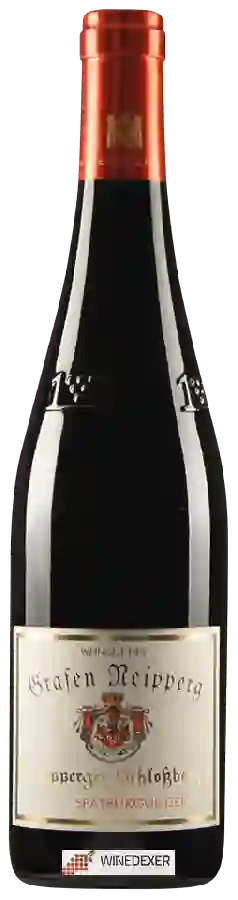
Winery Grafen NeippergNeipperger Schlossberg Spätburgunder
 Red wine


In the mouth this red wine is a with a nice freshness.
This wine generally goes well with poultry, beef or veal.

Taste structure of the Neipperger Schlossberg Spätburgunder from the Winery Grafen Neipperg
Light | Bold | |
Smooth | Tannic | |
Dry | Sweet | |
Soft | Acidic |
In the mouth the Neipperger Schlossberg Spätburgunder of Winery Grafen Neipperg in the region of Württemberg is a with a nice freshness.
Wine flavors and olphactive analysis



On the nose the Neipperger Schlossberg Spätburgunder of Winery Grafen Neipperg in the region of Württemberg often reveals types of flavors of non oak, earth or oak and sometimes also flavors of spices, red fruit or black fruit.
Food and wine pairings with Neipperger Schlossberg Spätburgunder
Pairings that work perfectly with Neipperger Schlossberg Spätburgunder



Original food and wine pairings with Neipperger Schlossberg Spätburgunder

The Neipperger Schlossberg Spätburgunder of Winery Grafen Neipperg matches generally quite well with dishes of beef, veal or game (deer, venison) such as recipes of stuffed peppers, veal liver in vinegar or real paella recipe from valencia.
Details and technical informations about Winery Grafen Neipperg's Neipperger Schlossberg Spätburgunder.
Discover the grape variety: Malvasia di Candia Aromatica
Versatile muscat-style whites — dry, frizzante or rich passito — with a pale to amber robe and an ample palate, featuring intense aromas of white flowers (elderflower, acacia), yellow fruits (apricot), muscat and honeyed notes in passito versions. Star of the Colli Piacentini DOC and Colli di Parma DOC in Emilia-Romagna. Aromatic Malvasia variety grown in central Italy.
Last vintages of this wine

The best vintages of Neipperger Schlossberg Spätburgunder from Winery Grafen Neipperg are 2015, 0, 2013
Informations about the Winery Grafen Neipperg
The Winery Grafen Neipperg is one of of the world's greatest estates. It offers 56 wines for sale in the of Württemberg to come and discover on site or to buy online.

The wine region of Württemberg
Rare predominantly red region in Germany (nearly 70%). Supple, fruity everyday reds: light, crisp Trollinger (Schiava) with red fruits, more structured, spicy, deep Lemberger (Blaufränkisch), generous Schwarzriesling (Pinot Meunier). Riesling king of whites (>2,000 ha), lively and mineral, citrus and green apple. Germany's 4th region (11,500 ha) on the Neckar slopes around Heilbronn and Stuttgart.
The word of the wine: Rootstock
American vine on which a French vine is grafted. This is the consequence of the phylloxera that destroyed the vineyard at the end of the 19th century: after much trial and error, it was discovered that the "pest" spared the roots of the American vines, and the technique became widespread.