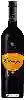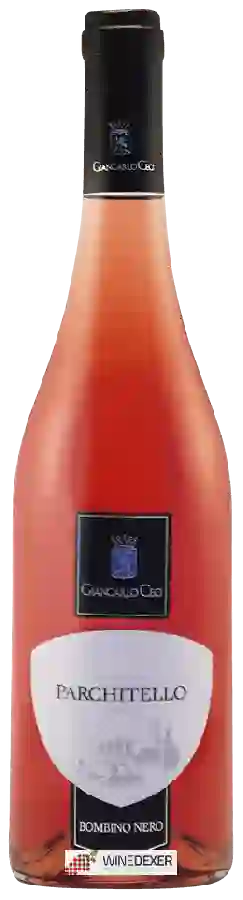
Winery Giancarlo CeciParchitello Bombino Nero
 Pink wine



This wine generally goes well with
The Parchitello Bombino Nero of the Winery Giancarlo Ceci is in the top 10 of wines of Puglia.
Wine flavors and olphactive analysis

On the nose the Parchitello Bombino Nero of Winery Giancarlo Ceci in the region of Puglia often reveals types of flavors of red fruit.
Details and technical informations about Winery Giancarlo Ceci's Parchitello Bombino Nero.
Discover the grape variety: Vidal blanc
An interspecific cross obtained by Jean-Louis Vidal, between Ugni Blanc and 4986 Seibel or Golden Ray, its foliage reminiscent of that of Ugni Blanc. It can be found in the United States and Canada, but is little known in France.
Last vintages of this wine
The best vintages of Parchitello Bombino Nero from Winery Giancarlo Ceci are 2014, 2018, 2016, 0 and 2015.
Informations about the Winery Giancarlo Ceci
The Winery Giancarlo Ceci is one of of the world's greatest estates. It offers 21 wines for sale in the of Puglia to come and discover on site or to buy online.

The wine region of Puglia
Puglia (Apulia to many English speakers) is a Long, slender wine region in the extreme Southeast corner of Italy's "boot". To use the shoe analogy often used to illustrate the shape of Italy, Apulia extends from the tip of the heel to the mid-calf, where the spur of the Gargano Peninsula juts out into the Adriatic Sea. The heel (the Salento peninsula) occupies the southern half of the region and is of great importance for the identity of Puglia. Not only are there cultural and geographical differences from Northern Puglia, but the wines are also different.
The word of the wine: Oenologist
Specialist in wine-making techniques. It is a profession and not a passion: one can be an oenophile without being an oenologist (and the opposite too!). Formerly attached to the Faculty of Pharmacy, oenology studies have become independent and have their own university course. Learning to make wine requires a good chemical background but also, increasingly, a good knowledge of the plant. Some oenologists work in laboratories (analysis). Others, the consulting oenologists, work directly in the properties.