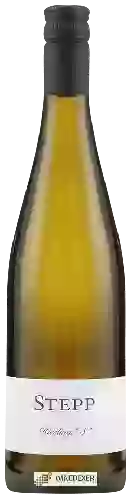
The Winery Stepp of Pfalz

The Winery Stepp is one of the best wineries to follow in Pfalz.. It offers 26 wines for sale in of Pfalz to come and discover on site or to buy online.
Looking for the best Winery Stepp wines in Pfalz among all the wines in the region? Check out our tops of the best red, white or effervescent Winery Stepp wines. Also find some food and wine pairings that may be suitable with the wines from this area. Learn more about the region and the Winery Stepp wines with technical and enological descriptions.
How Winery Stepp wines pair with each other generally quite well with dishes of pork, shellfish or spicy food such as recipes of roast pork in the oven, stuffed squid or pakistani rice (biryani).
On the nose the white wine of Winery Stepp. often reveals types of flavors of pineapple, grapefruit or tropical and sometimes also flavors of citrus, apples or peach. In the mouth the white wine of Winery Stepp. is a powerful with a nice freshness.
Fleshy, dry, fruity Riesling is the region's signature: yellow peach, apricot, ripe citrus, lovely mineral tension. Germany's largest red-wine area (40%), with silky Spätburgunder showing red fruit and spice, darker structured Dornfelder, supple Portugieser. Some rounded Pinot Blanc and Pinot Gris. A 23,640 ha vineyard along the Haardt, among Germany's warmest (>2,000 h of sun).
From gourmet everyday bottles to age-worthy wines.
How Winery Stepp wines pair with each other generally quite well with dishes of beef, veal or game (deer, venison) such as recipes of chinese noodles with beef, veal curry or lamb chops marinated with herbs.
On the nose the red wine of Winery Stepp. often reveals types of flavors of cream, cherry or oaky and sometimes also flavors of smoke, earthy or blackberry. In the mouth the red wine of Winery Stepp. is a with a nice freshness.
Aromatic, structured whites with lively acidity and a round mouth, featuring intense aromas of pink grapefruit, blackcurrant, passion fruit, white flowers and muscat notes. Made as aromatic dry wines (Trocken), off-dry (Kabinett, Spätlese) and especially sumptuous botrytised sweet wines (Auslese, Beerenauslese, Trockenbeerenauslese). Grown in Germany (Rheinhessen, Palatinate) and Austria. Created in 1916 by Georg Scheu in Alzey, a Riesling × Bukettrebe cross.
How Winery Stepp wines pair with each other generally quite well with dishes of shellfish, spicy food or poultry such as recipes of seafood risotto, fricassee of lambis or special' tagliatelle carbonara.
On the nose the sweet wine of Winery Stepp. often reveals types of flavors of non oak, earth or microbio and sometimes also flavors of oak, tree fruit or citrus fruit.
White, chalky deposits that occur as a result of precipitation inside bottles and are often considered by consumers as a defect. They are in fact tartaric salts formed by tartaric acid, potassium and calcium naturally present in the wine. This deposit does not alter the quality of the wine and can be eliminated by a simple decanting.
How Winery Stepp wines pair with each other generally quite well with dishes of veal, pork or game (deer, venison) such as recipes of guinea fowl with olives, croque madame or duck leg confit in white wine.
On the nose the pink wine of Winery Stepp. often reveals types of flavors of citrus fruit, red fruit.
Lively, structured dry whites with a pale golden robe, a taut palate and preserved acidity, showing refined and understated aromas of citrus (lemon), white flowers (acacia), green apple, fresh herbs and calcareous mineral notes. A terroir variety for young or aged drinking, with perfect soil transparency. The undisputed star of Franconia VDP, present in Alsace AOC and Austria. An indigenous Austrian variety, also called Sylvaner or Grüner Silvaner.
Planning a wine route in the of Pfalz? Here are the wineries to visit and the winemakers to meet during your trip in search of wines similar to Winery Stepp.
Elegant reds, light in colour with silky tannins, showing strawberry, cherry and raspberry aromas, evolving to forest floor, mushroom and spice with age. Fresh acidity, delicate finish. Star of the Côte d'Or (Romanée-Conti, Chambertin, Volnay), pillar of Champagne (Blanc de Noirs) and signature of Oregon, Central Otago and Sonoma Coast. An early-ripening Burgundian variety, one of the world's greatest.