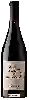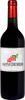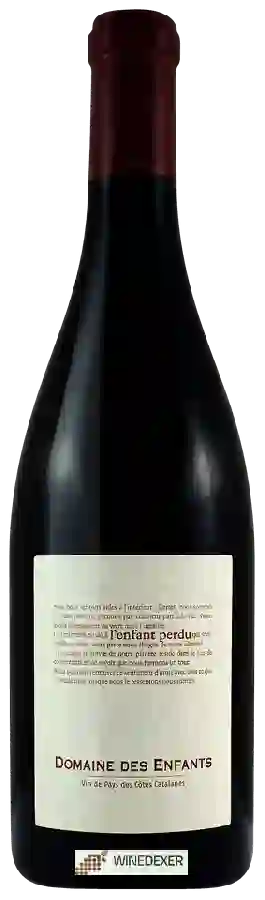
Domaine des EnfantsL'Enfant Perdu
 Red wine


This wine is a blend of 3 varietals which are the Carignan, the Syrah and the Grenache noir.
In the mouth this red wine is a powerful with a nice balance between acidity and tannins.
This wine generally goes well with beef, veal or pasta.
The L'Enfant Perdu of the Domaine des Enfants is in the top 30 of wines of Côtes Catalanes.

Taste structure of the L'Enfant Perdu from the Domaine des Enfants
Light | Bold | |
Smooth | Tannic | |
Dry | Sweet | |
Soft | Acidic |
In the mouth the L'Enfant Perdu of Domaine des Enfants in the region of Pays d'Oc is a powerful with a nice balance between acidity and tannins.
Wine flavors and olphactive analysis




On the nose the L'Enfant Perdu of Domaine des Enfants in the region of Pays d'Oc often reveals types of flavors of cherry, oaky or coffee and sometimes also flavors of licorice, plum or pepper.
Food and wine pairings with L'Enfant Perdu
Pairings that work perfectly with L'Enfant Perdu



Original food and wine pairings with L'Enfant Perdu
The L'Enfant Perdu of Domaine des Enfants matches generally quite well with dishes of beef, veal or pasta such as recipes of korean bibimbap, oriental stuffed vegetables or pasta with boursin.
Details and technical informations about Domaine des Enfants's L'Enfant Perdu.
Discover the grape variety: Carignan
Intensely coloured and powerful reds with a deep colour, firm tannins and high acidity, on aromas of blackberry, blackcurrant, plum, garrigue, pepper, liquorice and balsamic notes. Old vines (>50 years, often centenary) yield exceptional cuvées. A historical pillar of Languedoc-Roussillon blends (Corbières, Minervois, Fitou, Maury) and star of Catalan Priorat under the name Cariñena. Very late-ripening variety from Aragon, also called Mazuelo in Rioja.
Last vintages of this wine

The best vintages of L'Enfant Perdu from Domaine des Enfants are 2012, 2011, 2018, 2017 and 2016.
Informations about the Domaine des Enfants
The Domaine des Enfants is one of of the world's greatest estates. It offers 12 wines for sale in the of Côtes Catalanes to come and discover on site or to buy online.

The wine region of Côtes Catalanes
Expressive Roussillon heartland: signature Grenache Noir as the red king — fleshy and sunny with notes of ripe cherry, raspberry, garrigue, spices and a peppery touch, round tannins and generous alcohol on schist. Deep Syrah, dense Carignan and Mourvèdre as support. Grenache Gris/Blanc, Macabeu and Vermentino in round whites (fennel, citrus, flowers). Aromatic Muscats.
The wine region of Pays d'Oc
The single-grape IGP par excellence: modern, accessible, frank and fruity wines, the popular signature of the Midi. Spicy Syrah reds (pepper, blackberry), round Merlot, structured Cabernet, generous Grenache, supple Cinsault. Crisp, tangy rosés. Opulent Chardonnay whites, lively Sauvignon, floral, apricoty Viognier.
The word of the wine: Sulphites
Chemical compounds derived from sulphur (better known in the wine world as SO2) and used by winemakers for their antiseptic, antioxidant and antioxidant properties.