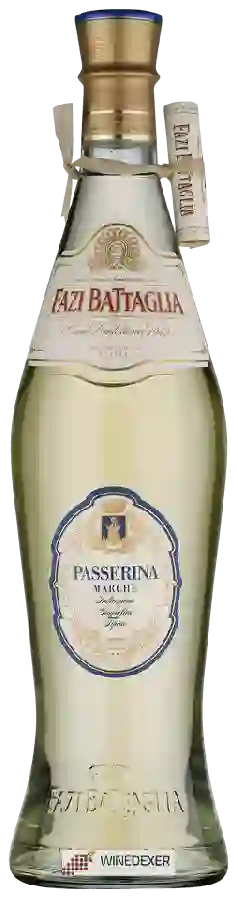
Winery Fazi BattagliaPasserina
 White wine



In the mouth this white wine is a powerful with a nice freshness.
This wine generally goes well with vegetarian, appetizers and snacks or lean fish.
Taste structure of the Passerina from the Winery Fazi Battaglia
Light | Bold | |
Dry | Sweet | |
Soft | Acidic |
In the mouth the Passerina of Winery Fazi Battaglia in the region of Marche is a powerful with a nice freshness.
Food and wine pairings with Passerina
Pairings that work perfectly with Passerina



Original food and wine pairings with Passerina


The Passerina of Winery Fazi Battaglia matches generally quite well with dishes of pasta, vegetarian or appetizers and snacks such as recipes of special' tagliatelle carbonara, vegan leek and tofu quiche or christmas boots in knacki.
Details and technical informations about Winery Fazi Battaglia's Passerina.
Discover the grape variety: Chasan
Chasan blanc is a grape variety that originated in France (Languedoc). It produces a variety of grape specially used for wine making. It is rare to find this grape to eat on our tables. This variety of grape is characterized by large bunches of grapes of medium size. Chasan blanc can be found in several vineyards: South-West, Cognac, Bordeaux, Languedoc & Roussillon, Loire Valley, Provence & Corsica, Rhone Valley, Savoie & Bugey, Beaujolais, Armagnac.
Last vintages of this wine
The best vintages of Passerina from Winery Fazi Battaglia are 2018, 2019, 0, 2017 and 1949.
Informations about the Winery Fazi Battaglia
The Winery Fazi Battaglia is one of of the world's greatest estates. It offers 27 wines for sale in the of Marche to come and discover on site or to buy online.

The wine region of Marche
Marche (or Le Marche; pronounced Mar-kay) is a region in eastern CentralItaly. It is most associated with white wines made from Trebbiano and Verdicchio grapes. Marche occupies a roughly triangular area. Its longer sides are formed by the Apennine Mountains to the west and the Adriatic Sea to the east.
The word of the wine: Sulphur
An antiseptic and antioxidant substance known since antiquity, probably already used by the Romans. But it was only in modern times that its use was rediscovered. It will allow a better conservation of the wine and thus favour its export. Sulphur also gave the 18th century winegrower the possibility of extending the maceration period without fearing that the wine would turn sour and thus go from dark rosé wines to the red wines of today. Excessive sulphur, on the other hand, kills happiness, paralysing the aromas and causing headaches.