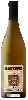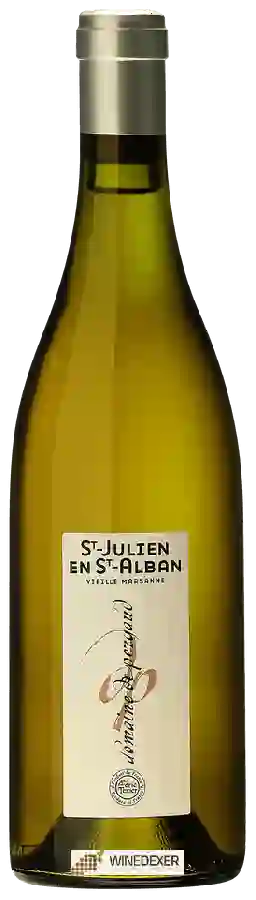
Winery Éric TexierDomaine de Pergaud Côtes du Rhône St-Julien en St-Alban Vieille Marsanne
 White wine


In the mouth this white wine is a powerful with a nice freshness.
This wine generally goes well with pork, poultry or rich fish (salmon, tuna etc).
Taste structure of the Domaine de Pergaud Côtes du Rhône St-Julien en St-Alban Vieille Marsanne from the Winery Éric Texier
Light | Bold | |
Dry | Sweet | |
Soft | Acidic |
In the mouth the Domaine de Pergaud Côtes du Rhône St-Julien en St-Alban Vieille Marsanne of Winery Éric Texier in the region of Rhone Valley is a powerful with a nice freshness.
Wine flavors and olphactive analysis






On the nose the Domaine de Pergaud Côtes du Rhône St-Julien en St-Alban Vieille Marsanne of Winery Éric Texier in the region of Rhone Valley often reveals types of flavors of pineapple, peach or butter and sometimes also flavors of apricot, pear or mushroom.
Food and wine pairings with Domaine de Pergaud Côtes du Rhône St-Julien en St-Alban Vieille Marsanne
Pairings that work perfectly with Domaine de Pergaud Côtes du Rhône St-Julien en St-Alban Vieille Marsanne



Original food and wine pairings with Domaine de Pergaud Côtes du Rhône St-Julien en St-Alban Vieille Marsanne


The Domaine de Pergaud Côtes du Rhône St-Julien en St-Alban Vieille Marsanne of Winery Éric Texier matches generally quite well with dishes of pork, rich fish (salmon, tuna etc) or mature and hard cheese such as recipes of light stuffed tomatoes, cannelloni with salmon and spinach or gratin in pink and blue.
Details and technical informations about Winery Éric Texier's Domaine de Pergaud Côtes du Rhône St-Julien en St-Alban Vieille Marsanne.
Discover the grape variety: Marsanne
Marsanne is a white grape variety that originated in Montélimar in the Drôme, several centuries ago. Marsanne is also found in Cassis, Savoie, Languedoc-Roussillon and Saint-Péray in the Ardèche, where it produces remarkable sparkling wines. The warm, sunny climate of the Rhone Valley, Languedoc-Roussillon and Provence, as well as the dry, stony soil, are ideal conditions for its development. Its bunches are quite large and provide small, juicy berries that are sensitive to grey rot and strong winds. These two grape varieties complement each other perfectly: together they give light wines with little acidity, aromas of yellow fruit, white fruit and flowers with notes of honey and liquorice. This is for example what the appellations Saint-Péray, Hermitage, Crozes-Hermitage, Saint-Joseph, Côtes-du-Vallée du Rhône, Corbières, or Cassis express... which represent about 700 hectares.
Last vintages of this wine

The best vintages of Domaine de Pergaud Côtes du Rhône St-Julien en St-Alban Vieille Marsanne from Winery Éric Texier are 2015, 2014, 2016
Informations about the Winery Éric Texier
The Winery Éric Texier is one of of the world's great estates. It offers 40 wines for sale in the of Côtes-du-Rhône to come and discover on site or to buy online.

The wine region of Côtes-du-Rhône
The wine region of Côtes-du-Rhône is located in the region of Rhône méridional of Rhone Valley of France. Wineries and vineyards like the Château de Beaucastel or the Chateau de Fonsalette produce mainly wines red, white and pink. The most planted grape varieties in the region of Côtes-du-Rhône are Mourvèdre, Viognier and Marsanne, they are then used in wines in blends or as a single variety. On the nose of Côtes-du-Rhône often reveals types of flavors of pineapple, red plum or sour cherry and sometimes also flavors of truffle, juniper or clove.
The wine region of Rhone Valley
The Rhone Valley is a key wine-producing region in Southeastern France. It follows the North-south course of the Rhône for nearly 240 km, from Lyon to the Rhône delta (Bouches-du-Rhône), near the Mediterranean coast. The Length of the valley means that Rhône wines are the product of a wide variety of soil types and mesoclimates. The viticultural areas of the region cover such a distance that there is a widely accepted division between its northern and southern parts.
The word of the wine: Deposit
Solid particles that can naturally coat the bottom of a bottle of wine. It is rather a guarantee that the wine has not been mistreated: in fact, to avoid the natural deposit, rather violent processes of filtration or cold passage (- 7 or - 8 °C) are used in order to precipitate the tartar (the small white crystals that some people confuse with crystallized sugar: just taste to dissuade you from it)