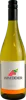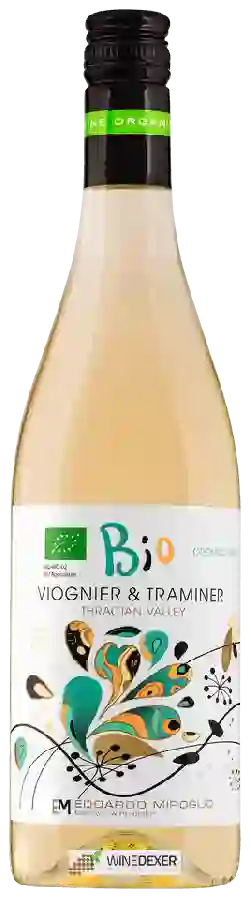
Winery Edoardo MiroglioBio Viognier - Traminer
 White wine



This wine generally goes well with pork, poultry or game (deer, venison).

Wine flavors and olphactive analysis




On the nose the Bio Viognier - Traminer of Winery Edoardo Miroglio in the region of Thracian Valley often reveals types of flavors of apples, peach or honeysuckle and sometimes also flavors of cheese, honey or straw.
Food and wine pairings with Bio Viognier - Traminer
Pairings that work perfectly with Bio Viognier - Traminer



Original food and wine pairings with Bio Viognier - Traminer



The Bio Viognier - Traminer of Winery Edoardo Miroglio matches generally quite well with dishes of pork, game (deer, venison) or shellfish such as recipes of wild boar bourguignon, duck sleeves in cider or garlic shrimp.
Details and technical informations about Winery Edoardo Miroglio's Bio Viognier - Traminer.
Discover the grape variety: Viognier
Opulent, heady whites, rich and silky, with intense aromas of apricot, yellow peach, mango, violet, honeysuckle and musky, honeyed notes. Discreet acidity, creamy finish. Star of Condrieu AOC and Château-Grillet AOC, co-vinified in Côte-Rôtie with Syrah (up to 20%). Widely exported to California (Central Coast), Australia (Eden Valley) and Languedoc. A Rhône variety.
Last vintages of this wine
The best vintages of Bio Viognier - Traminer from Winery Edoardo Miroglio are 2016, 2015, 2018, 2017 and 2014.
Informations about the Winery Edoardo Miroglio
The Winery Edoardo Miroglio is one of of the world's greatest estates. It offers 26 wines for sale in the of Thracian Valley to come and discover on site or to buy online.

The wine region of Thracian Valley
Bulgaria's largest wine region, land of identity-driven reds. Signature Mavrud around Plovdiv: a structured, tannic red with notes of blackberry, candied plum, dry herbs, leather and spices, long ageing. Fleshy, deep Rubin (Nebbiolo × Syrah cross), supple, fruity Pamid, dense Melnik 55. Aromatic Red Misket whites (rose, citrus).
The word of the wine: INAO glass
Glass adapted to wine tasting, created in the 1970s by the Institut national des appellations d'origine. At the time, it had the advantage of offering a standardised tool to all tasters. It is characterized by a wide base that allows for good ventilation and a narrow mouth (opening of the glass) to concentrate the aromas. Many high-performance glasses have been created based on this model.