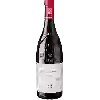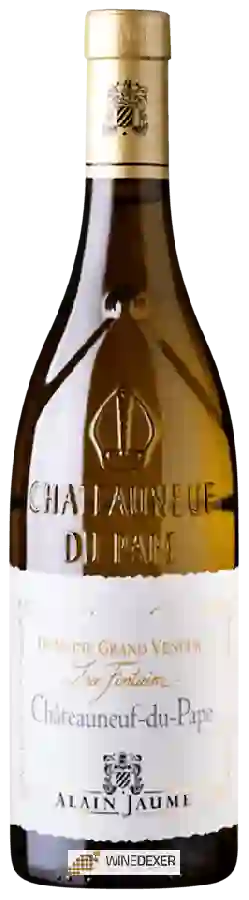
Winery Alain JaumeDomaine Grand Veneur Châteauneuf-Du-Pape La Fontaine Blanc
 White wine


This wine is composed of 100% of the grape variety Roussanne.
In the mouth this white wine is a powerful with a nice freshness.
This wine generally goes well with pork, poultry or rich fish (salmon, tuna etc).
The Domaine Grand Veneur Châteauneuf-Du-Pape La Fontaine Blanc of the Winery Alain Jaume is in the top 80 of wines of Châteauneuf-du-Pape.
Taste structure of the Domaine Grand Veneur Châteauneuf-Du-Pape La Fontaine Blanc from the Winery Alain Jaume
Light | Bold | |
Dry | Sweet | |
Soft | Acidic |
In the mouth the Domaine Grand Veneur Châteauneuf-Du-Pape La Fontaine Blanc of Winery Alain Jaume in the region of Rhone Valley is a powerful with a nice freshness.
Wine flavors and olphactive analysis






On the nose the Domaine Grand Veneur Châteauneuf-Du-Pape La Fontaine Blanc of Winery Alain Jaume in the region of Rhone Valley often reveals types of flavors of tropical, citrus or peach and sometimes also flavors of butter, vanilla or lemon.
Food and wine pairings with Domaine Grand Veneur Châteauneuf-Du-Pape La Fontaine Blanc
Pairings that work perfectly with Domaine Grand Veneur Châteauneuf-Du-Pape La Fontaine Blanc



Original food and wine pairings with Domaine Grand Veneur Châteauneuf-Du-Pape La Fontaine Blanc


The Domaine Grand Veneur Châteauneuf-Du-Pape La Fontaine Blanc of Winery Alain Jaume matches generally quite well with dishes of pork, rich fish (salmon, tuna etc) or mature and hard cheese such as recipes of savoyard pizza (cream base), salmon and spinach lasagna or titgazelle's herring and leek pie.
Details and technical informations about Winery Alain Jaume's Domaine Grand Veneur Châteauneuf-Du-Pape La Fontaine Blanc.
Discover the grape variety: Roussanne
Roussane is a white grape variety, planted on an area of more than 700 ha. Originally from Montélimar, it is also found in Savoie, Languedoc and Roussillon, and grows very well in calcareous, poor, stony soil. It prefers to be pruned short. Roussane is also called fromenteau, barbin or bergeron. The young leaves are bubbled with fine down. When adult, they become thicker. It flowers in June and matures in mid-September. The grapes are cylindrical in shape, the berries are small and turn red when ripe, and the wine produced from pure Roussane is of extraordinary quality. It has a delicate aroma reminiscent of coffee, honeysuckle, iris and peony. The taste of this wine improves with age. It is part of the blend of the appellations Vin-de-Savoie, Côtes-du-Vallée du Rhône or Châteauneuf-du-Pape.
Last vintages of this wine
The best vintages of Domaine Grand Veneur Châteauneuf-Du-Pape La Fontaine Blanc from Winery Alain Jaume are 2017, 2016, 2015, 2013 and 2012.
Informations about the Winery Alain Jaume
The Winery Alain Jaume is one of of the world's greatest estates. It offers 52 wines for sale in the of Châteauneuf-du-Pape to come and discover on site or to buy online.

The wine region of Châteauneuf-du-Pape
The wine region of Châteauneuf-du-Pape is located in the region of Rhône méridional of Rhone Valley of France. Wineries and vineyards like the Domaine Pegau or the Château Rayas produce mainly wines red and white. The most planted grape varieties in the region of Châteauneuf-du-Pape are Mourvèdre, Roussanne and Clairette, they are then used in wines in blends or as a single variety. On the nose of Châteauneuf-du-Pape often reveals types of flavors of iron, chestnut or red licorice and sometimes also flavors of tarragon, pencil shavings or cured meat.
The wine region of Rhone Valley
The Rhone Valley is a key wine-producing region in Southeastern France. It follows the North-south course of the Rhône for nearly 240 km, from Lyon to the Rhône delta (Bouches-du-Rhône), near the Mediterranean coast. The Length of the valley means that Rhône wines are the product of a wide variety of soil types and mesoclimates. The viticultural areas of the region cover such a distance that there is a widely accepted division between its northern and southern parts.
The word of the wine: Tertiary aromas
Aromas resulting from the aging of the wine in the bottle. The aromas evolve with time, from fresh fruitiness to notes of stewed, candied or dried fruit, to aromas of venison or undergrowth.