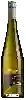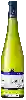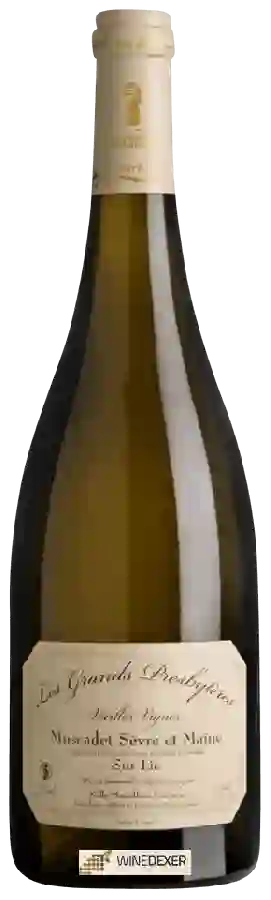
Domaine Les Grands PresbytèresVieilles Vignes Muscadet-Sèvre et Maine Sur Lie
 White wine



In the mouth this white wine is a with a nice freshness.
This wine generally goes well with appetizers and snacks, lean fish or shellfish.
The Vieilles Vignes Muscadet-Sèvre et Maine Sur Lie of the Domaine Les Grands Presbytères is in the top 70 of wines of Muscadet-Sevre et Maine.
Taste structure of the Vieilles Vignes Muscadet-Sèvre et Maine Sur Lie from the Domaine Les Grands Presbytères
Light | Bold | |
Dry | Sweet | |
Soft | Acidic |
In the mouth the Vieilles Vignes Muscadet-Sèvre et Maine Sur Lie of Domaine Les Grands Presbytères in the region of Loire Valley is a with a nice freshness.
Wine flavors and olphactive analysis


On the nose the Vieilles Vignes Muscadet-Sèvre et Maine Sur Lie of Domaine Les Grands Presbytères in the region of Loire Valley often reveals types of flavors of citrus, peach or lime and sometimes also flavors of minerality, lemon or pear.
Food and wine pairings with Vieilles Vignes Muscadet-Sèvre et Maine Sur Lie
Pairings that work perfectly with Vieilles Vignes Muscadet-Sèvre et Maine Sur Lie



Original food and wine pairings with Vieilles Vignes Muscadet-Sèvre et Maine Sur Lie

The Vieilles Vignes Muscadet-Sèvre et Maine Sur Lie of Domaine Les Grands Presbytères matches generally quite well with dishes of shellfish, appetizers and snacks or lean fish such as recipes of magic marinade (for shrimps, scallops, fish...), beet and goat aperitif verrines or fish curry à la reunion.
Details and technical informations about Domaine Les Grands Presbytères's Vieilles Vignes Muscadet-Sèvre et Maine Sur Lie.
Discover the grape variety: Muscat d'Alexandrie
Muscat of Alexandria is known under several dozen other names. From Zibibbu di Sicilia to Roman Muscat to Acherfield's early Muscat. Its rich repertoire of appellations comes from its popularity, as consumers prefer it to all other white grapes. More than 55,000 hectares of vineyards are planted with this grape throughout the world, and the Pyrenees Orientales is the best place to find it in France. Preferring long pruning, this grape variety displays excellent vigor. Its productivity is equally enviable, yielding up to 4 kilos per vine.Muscat d'Alexandrie is drought-resistant and promises very sweet, juicy and firm berries protected by a thin skin. The fruits are medium in size and gather in compact, narrow and long clusters of medium span. The musky flavour makes for very good natural sweet wines.
Last vintages of this wine
The best vintages of Vieilles Vignes Muscadet-Sèvre et Maine Sur Lie from Domaine Les Grands Presbytères are 2012, 2018, 2014, 2016 and 2013.
Informations about the Domaine Les Grands Presbytères
The Domaine Les Grands Presbytères is one of of the world's greatest estates. It offers 3 wines for sale in the of Muscadet-Sevre et Maine to come and discover on site or to buy online.

The wine region of Muscadet-Sevre et Maine
The wine region of Muscadet-Sevre et Maine is located in the region of Muscadet of Muscadet of France. Wineries and vineyards like the Domaine de l'Ecu or the Domaine de Bellevue produce mainly wines white and red. The most planted grape varieties in the region of Muscadet-Sevre et Maine are Melon, Muscadelle and Folle blanche, they are then used in wines in blends or as a single variety. On the nose of Muscadet-Sevre et Maine often reveals types of flavors of cream, asparagus or baked apple and sometimes also flavors of honeydew melon, hay or citrus zest.
The wine region of Loire Valley
The Loire Valley is a key wine region in western France. It follows the course of the Loire River on its Long journey through the heart of France, from the inland hills of the Auvergne to the plains of the French Atlantic coast near Nantes (Muscadet country). Important in terms of quantity and quality, the region produces large quantities (about 4 million h/l each year) of everyday wines, as well as some of France's greatest wines. Diversity is another of the region's major assets; the styles of wine produced here range from the light, tangy Muscadet to the Sweet, honeyed Bonnezeaux, the Sparkling whites of Vouvray and the juicy, Tannic reds of Chinon and Saumur.
The word of the wine: Heady
Said of a wine rich in alcohol, powerful and expressive.