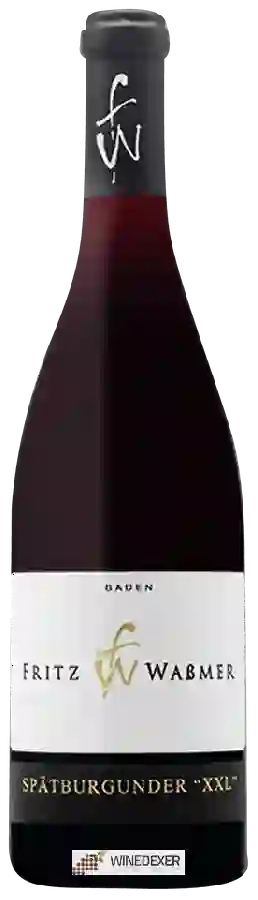
Winery Fritz WaßmerSpätburgunder XXL
 Red wine


In the mouth this red wine is a with a nice freshness.
This wine generally goes well with poultry, beef or veal.

Taste structure of the Spätburgunder XXL from the Winery Fritz Waßmer
Light | Bold | |
Smooth | Tannic | |
Dry | Sweet | |
Soft | Acidic |
In the mouth the Spätburgunder XXL of Winery Fritz Waßmer in the region of Baden is a with a nice freshness.
Wine flavors and olphactive analysis



On the nose the Spätburgunder XXL of Winery Fritz Waßmer in the region of Baden often reveals types of flavors of non oak, earth or oak and sometimes also flavors of red fruit.
Food and wine pairings with Spätburgunder XXL
Pairings that work perfectly with Spätburgunder XXL



Original food and wine pairings with Spätburgunder XXL

The Spätburgunder XXL of Winery Fritz Waßmer matches generally quite well with dishes of beef, veal or game (deer, venison) such as recipes of beer goulash, veal roast casserole or duck breast with honey, potato and onion with garlic.
Details and technical informations about Winery Fritz Waßmer's Spätburgunder XXL.
Discover the grape variety: Perle de Csaba
Table grape with medium bunches and golden berries with thin skin and aromatic muscat flesh, with a characteristic sweet aromatic flavour (rose, fresh grape). Very early ripening. Grown for fresh consumption in Hungary, Slovakia and the Czech Republic, marking the early summer season at Central European market stalls with its aromatic early-season table grapes. Hungarian table grape variety obtained in 1904 by Stark Adolf at Csaba (Chasselas × Muscat Ottonel).
Last vintages of this wine
The best vintages of Spätburgunder XXL from Winery Fritz Waßmer are 2015, 2014, 2012, 0 and 2013.
Informations about the Winery Fritz Waßmer
The Winery Fritz Waßmer is one of of the world's greatest estates. It offers 68 wines for sale in the of Baden to come and discover on site or to buy online.

The wine region of Baden
German capital of Pinot Noir (Spätburgunder): silky, fine reds with notes of red fruits, cherry, undergrowth and sweet spices, melted tannins. Round Grauburgunder (Pinot Gris), lively Weissburgunder, supple Müller-Thurgau, mineral Riesling. Germany's 3rd region (15,000 ha) in Baden-Württemberg facing Alsace, one of the country's warmest climates, volcanic soils at the Kaiserstuhl. Cradle of modern great German reds, elegant and fine.
The word of the wine: Ugni blanc
White grape variety of Italian origin, and the main white variety grown in France. Its large bunches give fine, light and lively wines, suitable for distillation: today it is the main variety for making cognac and armagnac. Ugni blanc, which is a little richer in alcohol when grown in Mediterranean regions, is used in the blending of the Provence and Corsica appellations, often in association with other grape varieties that bring aromas and structure, such as clairette, grenache blanc or sauvignon. Ugni blanc is also used, on a secondary basis, in the production of certain white wines in Gironde (AOC Bordeaux, Entre-deux-Mers, etc.).