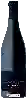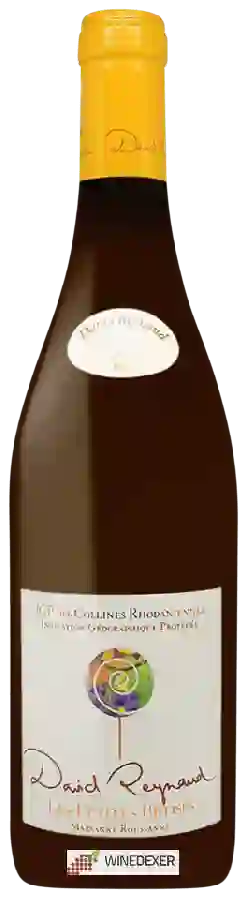
Winery David ReynaudLes Petites Bêtises Collines Rhodaniennes
 White wine



This wine is a blend of 2 varietals which are the Marsanne and the Roussanne.
In the mouth this white wine is a powerful.
This wine generally goes well with pork, vegetarian or poultry.
Taste structure of the Les Petites Bêtises Collines Rhodaniennes from the Winery David Reynaud
Light | Bold | |
Dry | Sweet | |
Soft | Acidic |
In the mouth the Les Petites Bêtises Collines Rhodaniennes of Winery David Reynaud in the region of Méditerranée is a powerful.
Wine flavors and olphactive analysis



On the nose the Les Petites Bêtises Collines Rhodaniennes of Winery David Reynaud in the region of Méditerranée often reveals types of flavors of earth, microbio or tree fruit and sometimes also flavors of citrus fruit.
Food and wine pairings with Les Petites Bêtises Collines Rhodaniennes
Pairings that work perfectly with Les Petites Bêtises Collines Rhodaniennes



Original food and wine pairings with Les Petites Bêtises Collines Rhodaniennes



The Les Petites Bêtises Collines Rhodaniennes of Winery David Reynaud matches generally quite well with dishes of pork, shellfish or poultry such as recipes of ham and cheese omelette, fish curry à la reunion or eggs florentine.
Details and technical informations about Winery David Reynaud's Les Petites Bêtises Collines Rhodaniennes.
Discover the grape variety: Marsanne
Marsanne is a white grape variety that originated in Montélimar in the Drôme, several centuries ago. Marsanne is also found in Cassis, Savoie, Languedoc-Roussillon and Saint-Péray in the Ardèche, where it produces remarkable sparkling wines. The warm, sunny climate of the Rhone Valley, Languedoc-Roussillon and Provence, as well as the dry, stony soil, are ideal conditions for its development. Its bunches are quite large and provide small, juicy berries that are sensitive to grey rot and strong winds. These two grape varieties complement each other perfectly: together they give light wines with little acidity, aromas of yellow fruit, white fruit and flowers with notes of honey and liquorice. This is for example what the appellations Saint-Péray, Hermitage, Crozes-Hermitage, Saint-Joseph, Côtes-du-Vallée du Rhône, Corbières, or Cassis express... which represent about 700 hectares.
Last vintages of this wine
The best vintages of Les Petites Bêtises Collines Rhodaniennes from Winery David Reynaud are 2020, 2019, 2021, 0 and 2018.
Informations about the Winery David Reynaud
The Winery David Reynaud is one of of the world's greatest estates. It offers 25 wines for sale in the of Collines Rhodaniennes to come and discover on site or to buy online.

The wine region of Collines Rhodaniennes
The wine region of Collines Rhodaniennes is located in the region of Méditerranée of Vin de Pays of France. Wineries and vineyards like the Domaine Les Vins de Vienne - Cuilleron-Gaillard-Villard or the Domaine Les Vins de Vienne - Cuilleron-Gaillard-Villard produce mainly wines red, white and pink. The most planted grape varieties in the region of Collines Rhodaniennes are Viognier, Marsanne and Roussanne, they are then used in wines in blends or as a single variety. On the nose of Collines Rhodaniennes often reveals types of flavors of red fruit, cassis or black olive and sometimes also flavors of black plum, rhubarb or savory.
The wine region of Méditerranée
Méditérranée is a PGI title that covers wines produced in a large area of the South-eastern coast of France, roughly corresponding to the wine region of Provence but also including Part of the Rhône Valley. The PGI shares its territory with multiple AOC appellations as varied as Châteauneuf-du-Pape, Bandol and Côtes de Provence. The PGI Méditérranée catchment area extends over 10 departments (including the two on the island of Corsica), as well as smaller parts of the Isère, Loire and Rhône departments. Viticulture is essential to the culture and economy of this part of France.
The word of the wine: Raw
A term whose meaning varies according to the region (terroir or estate), but which everywhere contains the idea of identifying a wine with a specific place of production.