The Winery Conde de Subirats of Catalogne
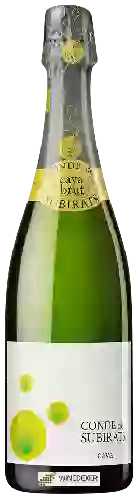
The Winery Conde de Subirats is one of the best wineries to follow in Catalogne.. It offers 2 wines for sale in of Catalogne to come and discover on site or to buy online.

Looking for the best Winery Conde de Subirats wines in Catalogne among all the wines in the region? Check out our tops of the best red, white or effervescent Winery Conde de Subirats wines. Also find some food and wine pairings that may be suitable with the wines from this area. Learn more about the region and the Winery Conde de Subirats wines with technical and enological descriptions.
How Winery Conde de Subirats wines pair with each other generally quite well with dishes of shellfish, appetizers and snacks or lean fish such as recipes of quick crayfish chicken, shrimp acras or the fisherman's catigot with gambas.
On the nose the sparkling wine of Winery Conde de Subirats. often reveals types of flavors of earth, microbio or oak and sometimes also flavors of tree fruit, citrus fruit or red fruit. In the mouth the sparkling wine of Winery Conde de Subirats. is a with a nice vivacity and a fine and pleasant bubble.
Catalonia (Catalunya in Catalan and Cataluña in Spanish) is an autonomous community in the Northeast of Spain. It extends from the historic county (comarca) of Montsia in the South to the border with France in the north. The Mediterranean Sea forms its eastern border and offers 580 km of coastline. The Catalunya D.
O. C. was the first regional D. O.
C. in Spain. Created in 1999, it covers all the scattered vineyards that were not covered by one of the other 11 DOs in the region. The capital of Catalonia is the bustling Barcelona, Spain's second largest city and one of the largest ports on the Mediterranean.
Planning a wine route in the of Catalogne? Here are the wineries to visit and the winemakers to meet during your trip in search of wines similar to Winery Conde de Subirats.
A very old grape variety found mainly in Catalonia (Spain), in the regions of Conca de Barbera and Costers del Segre, and also in the Balearic Islands, Murcia, Valencia, etc. It is said to be related to the white heben and has no link with the white trepat of Priorat. Before the phylloxera crisis, it could be found in Languedoc and Roussillon, which is no longer the case today, but it could be interesting for producing excellent and original rosé wines.