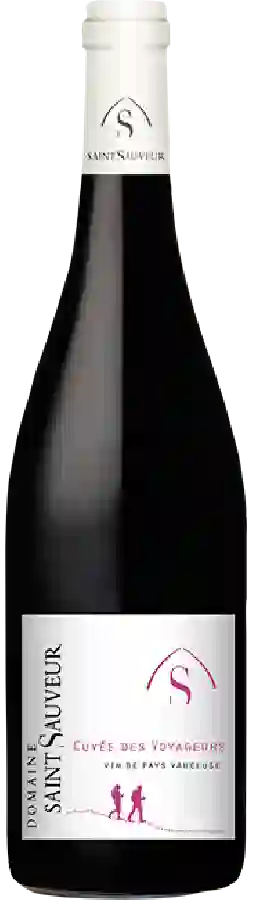
Château Saint SauveurCuvée des Voyageurs Rouge
 Red wine
In the mouth this red wine is a powerful with a nice balance between acidity and tannins.
This wine generally goes well with poultry, beef or veal.
Taste structure of the Cuvée des Voyageurs Rouge from the Château Saint Sauveur
Light | Bold | |
Smooth | Tannic | |
Dry | Sweet | |
Soft | Acidic |
In the mouth the Cuvée des Voyageurs Rouge of Château Saint Sauveur in the region of Pays d'Oc is a powerful with a nice balance between acidity and tannins.
Food and wine pairings with Cuvée des Voyageurs Rouge
Pairings that work perfectly with Cuvée des Voyageurs Rouge



Original food and wine pairings with Cuvée des Voyageurs Rouge

The Cuvée des Voyageurs Rouge of Château Saint Sauveur matches generally quite well with dishes of beef, veal or game (deer, venison) such as recipes of melt-in-the-mouth pork tenderloin casserole, veal chop with rosemary or stuffed duck or goose neck.
Details and technical informations about Château Saint Sauveur's Cuvée des Voyageurs Rouge.
Discover the grape variety: Herbemont
The origin of this American interspecific hybrid of the southern Vitis Aestivalis group, also called Vitis Bourquiniana, is not known for certain. In South Carolina (United States), it was propagated in the early 1800s by a Frenchman, Nicholas Herbemont (1771-1839), who found his first origins in Champagne. In France, it is one of six hybrids prohibited since 1935 (included in European regulations): Clinton, Herbemont, Isabelle, Jacquez, Noah and Othello. The Herbemont is very similar to the Jacquez - also called black spanish or lenoir - and has practically disappeared in favour of the latter.
Informations about the Château Saint Sauveur
The Château Saint Sauveur is one of of the world's greatest estates. It offers 13 wines for sale in the of Vin de Pays to come and discover on site or to buy online.

The wine region of Vin de Pays
Vin de Pays (VDP), the French national equivalent of PGI (Protected Geographical Indication) at the European level, is a quality category of French wines, positioned between Vin de Table (VDT) and Appellation d'Origine Contrôlée (AOC). This layer of the French appellation system was initially introduced in September 1968 by the INAO, the official appellation authority. It underwent several early revisions in the 1970s, followed by substantial changes in September 2000 and again in 2009, when all existing VDT titles were automatically registered with the European Union as PGI. Producers retain the choice of using either the VDP or PGI titles on their labels, or both - in the form "IGP-Vin de Pays".
The wine region of Pays d'Oc
Pays d'Oc is the PGI for red, white and rosé wines that are produced over a wide area of the southern coast of France. The PGI catchment area corresponds roughly to the Languedoc-roussillon">Languedoc-Roussillon wine region, one of the largest wine regions in France. The area covers all wines that are not produced under the strict laws that govern AOC-level appellations in the regions: among them, Corbières, Minervois and the Languedoc appellation itself. The Pays d'Oc PGI is arguably the most important in France, producing the majority of the country's PGI wines.
The word of the wine: Musk
A sensual, full-bodied animal substance used in luxury perfumery, produced by a small deer, the musk deer, also called musk deer.