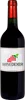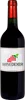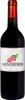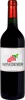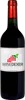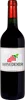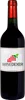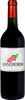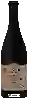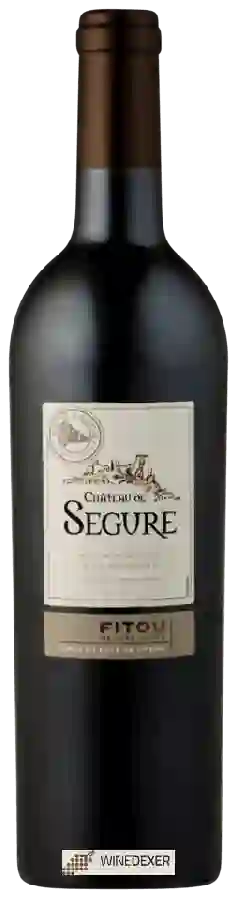
Château de SégureVieilles Vignes Fitou
 Red wine


In the mouth this red wine is a powerful with a nice balance between acidity and tannins.
This wine generally goes well with beef, veal or pasta.
Taste structure of the Vieilles Vignes Fitou from the Château de Ségure
Light | Bold | |
Smooth | Tannic | |
Dry | Sweet | |
Soft | Acidic |
In the mouth the Vieilles Vignes Fitou of Château de Ségure in the region of Languedoc-Roussillon is a powerful with a nice balance between acidity and tannins.
Wine flavors and olphactive analysis


On the nose the Vieilles Vignes Fitou of Château de Ségure in the region of Languedoc-Roussillon often reveals types of flavors of tobacco, non oak or earth and sometimes also flavors of oak.
Food and wine pairings with Vieilles Vignes Fitou
Pairings that work perfectly with Vieilles Vignes Fitou



Original food and wine pairings with Vieilles Vignes Fitou
The Vieilles Vignes Fitou of Château de Ségure matches generally quite well with dishes of beef, pasta or veal such as recipes of simple baked roast beef, quiche with mixed vegetables or veal chop with rosemary.
Details and technical informations about Château de Ségure's Vieilles Vignes Fitou.
Discover the grape variety: Gaillard 157
Interspecific crossing carried out in 1891 by Fernand Gaillard (1821-1905) between (triumph x eumelan) and 1 Seibel. This direct-producing hybrid was multiplied in particular in the south-west and centre-west of France as well as in the departments of the Rhône valley and the Ain.
Last vintages of this wine
The best vintages of Vieilles Vignes Fitou from Château de Ségure are 2017
Informations about the Château de Ségure
The Château de Ségure is one of of the world's greatest estates. It offers 4 wines for sale in the of Fitou to come and discover on site or to buy online.

The wine region of Fitou
Fitou is a red wine appellation in the heart of the Languedoc-Roussillon wine region in southern France. The wine takes its name from a small Village located a few kilometres from the Mediterranean coast. The typical Fitou wine is not dissimilar to the reds produced in the neighbouring Corbières (i. e.
The wine region of Languedoc-Roussillon
Languedoc (formerly Coteaux du Languedoc) is a key appellation used in the Languedoc-Roussillon wine region of southern France. It covers Dry table wines of all three colors (red, white and rosé) from the entire region, but leaves Sweet and Sparkling wines to other more specialized appellations. About 75% of all Languedoc wines are red, with the remaining 25% split roughly down the middle between whites and rosés. The appellation covers most of the Languedoc region and almost a third of all the vineyards in France.
The word of the wine: White winemaking
White wines are obtained by fermentation of the juice after pressing. A pre-fermentation maceration is sometimes practiced to extract the aromatic substances from the skins. White wines are normally made from white grapes, but can also be made from red grapes (blanc de noirs). The grapes are then pressed as soon as they arrive at the vat house without maceration in order to prevent the colouring matter contained in the skins from "staining" the wine.